
Oliver's Bookshelf | Spalding Library | Mormon Classics | Newspapers | Book Vault
|
John Taylor (1808-1887) Three Nights' Public Discussion (Liverpool: 1850) |

|
Udney Jacob's Peace Maker (1842) | Pratt's "Plurality of Wives" (1852) | 1852 message
|
THREE NIGHTS PUBLIC DISCUSSION BETWEEN THE REVDS. C. W. CLEEVE, JAMES ROBERTSON, AND PHILIP CATER, AND ELDER JOHN TAYLOR, OF THE Church of Jesus Christ of Latter-day Saints, AT BOULOGNE-SUR-MER, FRANCE. CHAIRMAN, REV. K. GROVES, M.A., ASSISTED BY CHARLES TOWNLEY, LL.D., AND MR. LUDDY. ___________________ ALSO A R E P L Y TO THE REV. K. GROVES, M.A., & CHARLES TOWNLEY, LL.D. Price Eightpence each. LIVERPOOL: PUBLISHED BY JOHN TAYLOR, AND FOR SALE BY O. PRATT, AT 15, WILTON STREET, AND BY AGENTS THROUGHOUT GREAT BRITAIN AND IN BOULOGNE. 1850. |
|
[ 1 ]
ACCORDING to my appointment to France by the authorities of the Church at the Great Salt Lake City, I arrived at the town of Boulogne-sur-mer, in company with Curtis E. Bolton, John Pack, and W. Howell, for the purpose of preaching the principles of the Everlasting Gospel. Soon after our arrival I published two communications in the Boulogne Interpreter, giving an account of the visit of the Angel to Joseph Smith, the coming forth of the Book of Mormon, and the first principles of the Gospel of Jesus Christ. These were published both in French and English. I also took a hall in the central part of the town, for the purpose of delivering a course of lectures, and gave public notice in hand bills and in the newspaper. After the lecture on the first evening, a Mr. Robertson, an Independent Minister, arose and wished to have the privilege of asking a few questions. I told him that I would answer as many as he pleased, either at my house or his, but could not admit of any thing that might lead to a disturbance. He then stated that he wished to do it for the good of the public, as he had some friends there. I told him if it were his friends he was interested about, he could bring them with him, or I would meet them either at his house or mine. Concerning the public, he could leave them to me; I was going to give them the necessary information in my lectures, but I could not, and would not, be interrupted in my meetings. He followed us on our way home, any seemed very anxious to converse, but soon manifested a wicked spirit. A Baptist Preacher who accompanied him, was also very officious. They stated that "Joe" Smith was an impostor, and they could prove it. I told them to prove whatever that liked in their own way, I cared nothing for their opinions -- that I was personally acquainted with Joseph Smith -- that he was a gentleman, and would not treat a stranger as they had treated me -- that I wished no further conversation with them. They still dogged after me, but I answered them no further. The same men had disturbed Brother Howell's meetings before, of which he had informed me. On the 4th July we received the following note by a messenger, who wished to know when he should call for an answer. I told him next day at twelve o'clock, that as I was a stranger in the place, I would not take any steps of that kind without consulting the Mayor. Boulogne-sur-mer. "To Messrs. John Taylor, Curtis E. Bolton, John Pack, and W. Howell, Mormonites."Sirs, -- The extraordinary nature of your pretensions and announcements, made us desirous of having their validity and truth enquired into, at the meetings called by yourselves and before the people whom you address; but as you have declined all public investigation at your own meetings, we have judged it proper to address to you to you this respectful public challenge, to meet us in open and public debate, in order that the validity of your pretensions, and the truth of your announcements may be fairly and publicly investigated. The following are some of the points which we are desirous of having submitted to an open and public investigation: "1st. -- The late Joseph Smith. The origin and course of his public and pretended religious career. Was he a truthful and honest man, or a blasphemous and daring impostor? "2nd. -- The Book of Mormon. Is it, as you pretend, a revelation from God? What are the pretended facts of its discovery." Is it not a stupid and ignorant farrago of nonsense? 2 PUBLIC DISCUSSION. Is it not the spoiled production of a man who wrote a parody for his own amusement, but who never would have dared to offer it as a revelation from God? What must be the character of the party who exhibit such a book to the world as a Divine Revelation, and of equal authority with the sacred writings of the Old and New Testament? "3rd. -- Yourselves! The pretended facts of your Direct Appointment by God, to preach what you call the Gospel. The circumstances and nature of the Divine Revelation to which you lay claim. The mode in which you carry out your pretended divine commission. Your pretended miracles and signs. What are they? Are they true or false? "Until those and kindred points are fully investigated and settled to the satisfaction of honest men, we presume that your attempts at the exposition of the Word of God, may well be spared, as you can scarcely expect to be listened to with respect, while the suspicions which now attach to you are unremoved, and while you are viewed as the representatives of one of the clumsiest and most blasphemous impostures which has ever been attempted to be palmed upon the ignorant and credulous of mankind. If you accept of our challenge, the time, place, and conditions of the investigation can be mutually arranged. "Waiting the favour of your answer, we have the honour to be, "Sirs, "Your most obedient servants, "JAMES ROBERTSON, "PHILIP CATER." I enclosed this communication to his Worship the Mayor, who wrote a very polite note, informing me that there would be no objection to such a meeting. We then addressed the following note to those gentlemen:-- "Boulogue-sur-mer, July 5. "Messrs. C. W. Cleeve, James Robertson, and Philip Cater."Gentlemen, -- We received your singular production, which we consider rather an uncourteous document from gentlemen of your profession. "Were we not strangers here, we should pay no attention to it. As it is, we think proper to accept; but as it is unnecessary for so many to engage in a discussion of this kind, we have appointed Mr. Taylor on our behalf. "Gentlemen, "Yours obediently, JOHN PACK, CURTIS E. BOLTON, WILLIAM HOWELL." "Gentlemen, -- In this matter I shall expect half of the time, and A fair and equitable arrangement, the which, I, as a matter of course, shall he consulted about. I, at the same time, engage to prove the doctrines that you profess, to be false and unscriptural, and that you have no legal authority to preach the Gospel of Jesus Christ. And surely, gentlemen, such champions need be under no fears from the advocate of so 'clumsy and blasphemous a thing' as the one you say we represent. JOHN TAYLOR." I must say that I considered the note too ungentlemanly, abusive, and insulting to be deserving of notice. I should have considered it and its authors worthy only of contempt, had I been in a place where I was known; as it was, I thought that men who could condescend to make such foul insinuations and base assertions, would not fail to impugn my motives, and circulate every species of falsehood that had been hatched up by their brethren in America. I might have objected to the form of the PUBLIC DISCUSSION. 3 document also, as I had scarcely any written rebutting testimony with me; but I had Brothers Bolton and Pack, both of whom knew Joseph as well as myself; therefore I thought it best to take it just as it was, and meet them on their own ground. I would here remark, however, that I do not consider an elder is responsible for anything but the doctrine that he preaches; if he himself be a virtuous man and preaches pure principles, what has he to do with the conduct of another? I judge him by his words and works. The eternal truths of heaven are independent of the conduct of any man. Two and two are four, whether I am a good man or not; three and five will never make seven, however good and virtuous the man who utters it. The Gospel that was taught by Jesus is true, whoever teaches it. The systems of men, which are contrary to the scriptures are not true, nor are they the Gospel, however pious and sanctimonious the men may be who teaches them. I would not, however, infer that wicked men teach good principles, for if the tree be good, the fruit will be good, but that truth is independent of the conduct of men. Men of vitiated tastes very often choose unwholesome food. Birds and beasts also live on that which accords with their natures: the sheep, the ox, and the dove feed on clean wholesome food; while the wolf, raven, and vulture are fond of carrion. As these gentlemen wished to handle filthy things, I thought I would humour them for once, but only think of the idea of three ministers associated with others, meeting in a debate, not to prove a doctrine false by the scriptures, which, as divines they ought to be well able to do, but which they did not attempt: but to try to prove a man's character to be bad, from newspaper stories and unauthenticated reports. What would become of Christianity with such a test? what of Catholicism, Protestantism, and every other "ism" associated with poor erring humanity? And if the scriptures are true that say, "out of the abundance of the heart the mouth speaketh," what must be the situation of that bosom which belches out such foul statements as those contained in the following debate. It reminds me of Isaiah's remark, "When the overflowing scourge shall pass through, it shall not come nigh us, for we have made lies our refuge, and under falsehood have we hid ourselves." Boulogue-sur-mer, July 11, 1850. Minutes of a Discussion held between the Revds. C. W. Cleeve, James Robertson, and Philip Cater, and Elder John Taylor, of the Church of Jesus Christ of Latter-day Saints. Taken by Curtis E. Bolton. Chairman. -- The Rev. K. Groves, M. A., Clergyman of the Church of England, assisted by Charles Townley, LL.D., and Mr. Luddy. First -- the following agreement, made by the parties, was read: -- Boulogne-sur-mer, July 6th, 1850. Minutes of a Meeting held at No. 15, Rue de la Lampe, between the Revds. C. W. Cleeve, James Robertson, and Philip Cater, on the one side, and Elders John Taylor, John Pack, Curtis E. Bolton, and William Howell, on the other side, to arrange for a public discussion to be held in this town; which discussion is to be conducted in the following manner: -- 2. -- That each party choose a Chairman, and they two select a third. 3. -- That the subject of discussion be as follows, viz. -- First, the late Joseph Smith: his public and pretended religious career. Second, the Book of Mormon: is it a revelation from God? Third, are the ministers of that people sent of God by direct appointment? 4. -- That Mr. Taylor will have the privilege of discussing the validity of the faith and calling of his opponents. 5. -- That the first meeting be held on Thursday evening, the 11th of July, at seven o'clock, to continue till ten p.m.; and be continued on from evening to evening, Sunday excepted. 6. -- That the sum of half a franc be charged for admittance; and that out of the proceeds the expenses of the discussion be first paid, and the surplus, if any, be equally divided, one half to be given to the Mayor, and the other half to the English Consul for the benefit of the poor. 4 PUBLIC DISCUSSION. 7. -- That should there be any deficiency, each side of this discussion make up an equal proportion to defray the same. JAMES ROBERTSON, JOHN PACK, PHlLIP CATER, CURTIS E. BOLTON, WILLIAM HOWELL. FIRST NIGHT'S DISCUSSION. Mr. Groves requested, for reasons that he would not explain, that each individual should engage for four or five minutes in quiet silent prayer.Chairman. -- It is unnecessary for me to make many remarks on the present occasion, but leave it for the parties engaged. Generally persons are chosen to grace the office but here the office must grace the person. I would particularly request the auditor to abstain from any mark of approbation or disapprobation. The Rev. C. W. Cleeve* then said, it became his task to take the initiative in this discussion, and in doing so he deprecated all acrimony or personality, and disavowed altogether any hostile feeling towards the persons, whom he and his friends had thought it right to call upon to prove their very extraordinary pretensions. He (Mr. C.) was strong opposed to public religious discussions, but there are occasions when we are seriously called upon to contend for the faith, and to unmask error and imposture -- there are occasions, when not to do this would be a gross dereliction of Christian duty. Such an occasion he conceived the present to be. He did not attack men, but a system -- a system that he declared to have not the slightest claim to be called a Christian sect. He and his opponents were not there to debate a difference, as persons believing a common Christianity. They were not there to dispute slight discrepancies in a common faith. Had his opponents preached the great doctrine of the Christian faith, as taken from the Bible, he and his friends would not have been there to oppose them; but they had cited Mr. Taylor and his friends, not as teachers of any form of Christianity, but as emissaries and advocates of the vilest imposture since the days of Mahomet. Such language would be unwarrantable towards any denomination of Christians; but, Christians his opponents were not -- they were advocates of an imposture by no means unimportant or unsuccessful; it was spreading amongst the uneducated in all directions -- it was numbering its victims by tens of thousands, and it became the duty of every one to expose its audacious and fatal errors. The first question of discussion is, Was Joseph Smith an impostor? for if he was, there was an end of Mormonism. Had Moses been an impostor, the Old Testament dispensation must have fallen to the ground. If the Redeemer had been an impostor, the gospel could not have been true; and by the same rule, if this person, Joseph Smith, was an impostor, the whole of this pretended system is a fraud. The Rev. gentleman then proceeded to read general extracts from a work by the Rev. Henry Caswell, General Bennett, and others, and an article from the English Review, charging Joseph Smith and the Mormonites with a number of crimes and immoralities. (We regret that we have been unable to obtain copies of these extract.) Elder Taylor, -- Gentlemen and Christian friends, I stand here as a stranger in your midst; I have travelled many thousands of miles for the purpose of coming to this land to preach the Gospel along with my brethren. Whatever may be the views of men in relation to our principles, all must accord that our being here on such a mission, so far from our families and homes, is evidence, at least, of our sincerity. I have listened to some strange remarks and infamous statements, made by the gentleman who has just sat down, the which, if the thousandth part were true, I should not have been here on this present occasion; and I think, that before I get through, I shall be able to shew that we are not such daring impostors, nor blasphemers -- that __________ * Lest I should be considered partial, I give the speeches of the opposing parties as reported from the Boulogne Interpreter, July 18. I was informed that they refused to let the Editor have those books. -- J. T. PUBLIC DISCUSSION. 5 we are not so corrupt, nor are we the immoral, degraded, and polluted wretches that the gentleman would represent us to be; but that our doctrine is as scriptural, that our conduct is as moral, and our lives as virtuous, as his or his friends, or that of any other people in the world; and let me remark, that such foul aspersions and bitter language would become other lips, and another profession than that of my Rev. friend. I do not wish to cherish in my bosom such bitterness nor wrath, nor to have such angry, vindictive, unbecoming words flow from my lips. These are certainly strange weapons for divines to combat error with. If a doctrine be false, why not prove it so by the Word of God, without having recourse to such subterfuges. "To the law and to the testimony," says Isaiah, "if they speak not according to that, it is because there is no truth in them." Neither do I consider that the foundation of eternal truth rests upon the character of any man, much less upon false reports, newspaper stories, and the unauthenticated statements of wicked and corrupt men. Mr. Cleeve stated that it gave him pain to have to meet me. I would remark that it was a pain that he might easily have dispensed with. I have not disturbed anybody in this place, nor interfered with Mr. Cleeve, or either of the other gentlemen. I had taken a hall, and was quietly lecturing in it, when Mr. Robertson came and wished to ask some questions. I told him that I would answer as many as he pleased at his house; but that I did not wish to have the meeting disturbed. Chairman. -- We do not wish any personal allusions. Elder Taylor. -- I think, sir, I am not out of the way. I think, with all deference, I have as much right to explain why I am here as my opponents. (Cries, "Go on! go on!") Chairman conceded. Elder Taylor. -- I did not court this discussion. I am here to answer to certain charges which these gentlemen have thought proper to bring against me and my doctrines. If they had not hatched up this concern, I should not have been here to-night. On the other hand, I will that, although I court not discussion, yet I never shrink, on proper occasions, from an investigation of those principles which I most assuredly believe. If these gentleman, or any one else, have any principles of truth that I do not possess, I will promise to embrace them. If, on the other hand, they will shew me that I am in error, I will promise to forsake it. I have heard a great deal said about Joseph Smith and his character. I was intimately acquainted with the late Joseph Smith, and know that the statements made by Mr. Cleeve are untrue. I have been with Mr. Smith for years; I have travelled with him; I have been with him in public and in private, at home and abroad; I was with him living, and when he died -- when he was murdered in Carthage jail, and I can testify that he was a virtuous, moral, high-minded man -- a christian and a philanthropist. My brethren here, Messrs. Pack and Bolton, were also acquainted with him, and, if required, will certify to the same thing. In relation to the characters who made those statements, I happen to be acquainted with them, and know of the circumstances under which some of them were written. Concerning Mr. Caswell, I was at Nauvoo during the time of his visit. He came for the purpose of looking for evil. He was a wicked man, and associated with reprobates, mobocrats, and murderers. It is, I suppose, true that he was reverend gentleman; but it has been no uncommon thing with us to witness associations of this kind, nor for reverend gentlemen; so called, to be found leading on mobs to deeds of plunder and death. I saw Mr. Caswell in the printing office at Nauvoo; he had with him an old manuscript, and professed to be anxious to know what it was. I looked at it, and told him that I believed it was a Greek manuscript. In his book, he states that it was a Greek Psalter; but that none of the Mormons told him what it was. Herein is a falsehood, for I told him. Yet these are the men and books that we are to have our evidence from. Concerning Mr. Turner, of Jacksonville college, Illinois, we have had his opinion; but what has opinion to do with truth? It was the opinion of men, in every age of the world, that the prophets were imposters, and they killed them because of their belief. They were whipped, tried, tempted, torn asunder, wandered about in sheep skins, &c. And why? Because it was the opinion of the people that they were wicked -- and the opinion, generally, of the most learned and pious. Hence, the Jews killed their prophets, beheaded John the Baptist, crucified the Messiah, and persecuted his Apostles; and the Chief Priests, 6 PUBLIC DISCUSSION. Rabbis and Doctors were foremost. Respecting John C. Bennett; I was well acquainted with him. At one time he was a good man, but fell into adultery, and was cut off from the church for his iniquity; and so bad was his conduct, that he was also expelled the Municipal Court, of which he was a member. He then went lecturing through the country, and commenced writing pamphlets for the sake of making money, charging so much for admittance to his lectures, and selling his slanders. His remarks, however, were so bad, and his statements so obscene and disgraceful, that respectable people were disgusted. These infamous lies and obscene stories, however, have been found very palatable to a certain class of society, and in times of our persecutions multitudes were pleased with them. Hence, not only did it suit the inclination of these gentlemen above alluded to, but preying upon the cupidity of the uninformed, they made a very lucrative business of their disgusting traffic, and sold it to the world garnished with the names of Doctor Bennett, the Rev. Mr. Turner, the Rev. Mr. Caswell, and numbers of other reverends, associates of blacklegs and murderers. Hence we have awful disclosures! terrible iniquity! horrid blasphemy! ornamented and dressed off by the aforesaid reverends, and rewritten, republished, and circulated by their brethren in this country. (Mr. Cleeve, I could furnish you with thousands of such statements, if they are of any use to you.) I say now, as I said before, that reports have nothing to do with truth; and I will say moreover, that public opinion has very little to do with it. The testimony of Noah was just as true, although rejected by the Antedilavians, as that of Jonah when all the inhabitants of Nineveh repented in sackcloth and ashes. And Jesus's testimony was just as true, when they cried, "Crucify him! crucify him!" and he was just as pure and virtuous as he was when the people strewed branches in the way, and spread their garments for him to ride over, and cried "Hosannah! blessed is he that cometh in the name of the Lord." And St. Paul's testimony was just as true, when he was stripped and imprisoned, as when the people of Lycaonia said, concerning him and Barnabas, "The Gods have come down to us in the likeness of men," and would have worshipped them. Truth has always been opposed by the children of men, it comes in contact with the corrupt hearts and wicked practices. The Prophets have always been persecuted; and why? because they dared to tell the word of the Lord to the people. Stephen, in speaking on the same subjects, says, "Which of the Prophets have not your forefathers killed who testified before of the coming of the Just One, of whom ye have been the betrayers and murderers? "But in this age," say the people, "we know they were wicked and we would not have done that." So said the Jews to Jesus, and yet they crucified him. And he told them that while they killed the living Prophets, they would garnish the sepulchres of the dead -- "Woe unto you, Scribes and Pharisees, hypocrites; because ye build the tombs of the Prophets, and garnish the sepulchres of the righteous, and say, if we had been in the days of our fathers we would not have been partakers with them in the blood of the Prophets." In these days, God has sent an Holy Angel, (as he before testified), "having the everlasting gospel to preach, to every nation, and kindred, and people, and tongue; crying, with a loud voice, fear God and give glory to Him, for the hour of His judgment is come." The Lord has restored the Gospel as it existed in the Apostle's days. This Gospel does not agree with the systems of men, which are conflicting and various; and instead of acknowledging, as honest men, the truths contained in the Bible, which they profess to believe, but, in reality do not, they try to cover over their tottering systems and unscriptural theories, to wrap themselves in their cloak of self-righteousness, and cry, "the Temple of the Lord -- the Temple of the Lord -- the Temple of the Lord are we." And instead of meeting what they call error with the scriptures, and testing it with the touchstone of truth, like the persecutors of the Prophets, they substitute vituperation, scandal, persecution, and abuse; and as they know that error, cannot combat the truth, they tread in the steps of their venerable predecessors, the Pharisees, who called Jesus an impostor; and that he cast out devils through Beelzebub, the prince of devils; declared that he was born of fornication, and accused him of blasphemy. So the same kind of persons, in these days, in the absence of truth, seek to undermine the character of a good, honourable, and virtuous man. Hence, we hear the hue-and-cry of false prophet, impostor, deceiver, blasphemer, adulterer, daring imposters, &c. Ministers in America join with the drunkard, profligate, and murderer, to PUBLIC DISCUSSION. 7 hitch up stories against the Saints, and we have an importation to this country, circulated by pious people, revised and reprinted by ministers for the same purpose. Gentlemen, men of your calling ought to use other weapons. What do you gain by this system? All honorable men are ashamed of it, and it does not prove your doctrines true. Suppose Joseph Smith was all you represent him to be, your systems are still as unscriptural; and the next thing you will have to do will be to prove the scriptures false, if you would sustain them. The eternal truths of God are still the same; and whether Joseph Smith was a good or a bad man, the truths we preach are scriptural, and you cannot gainsay them; and if they are, what avails your attack upon character? Your soporiferous draughts may lull the people to sleep for a while, but truth will roll forth; the honest in heart will be aroused from their slumber; the purposes of God will roll forth; the kingdom of God will be established, and in spite of your puny efforts, truth will stand proud and erect, unsullied and uncontaminated by the pestiferous breath of calumniating mortals, and no power can stay its progress. Mr. Robertson (Independent Minister, I suppose,) considered it proper to account for his present position. He had heard of the bold and audacious pretensions of these so-called Latter-day Saints, for the meeting must know, that of the persons challenged, one is no less than an Apostle of Jesus Christ, claiming authority equal with that of St. Peter and St. Paul, and the rest are High priests. Chairman. -- It is not proper to read a speech. Mr. Robertson. -- I think I have a right. I don't see what difference it can make. Chairman (to Mr. Taylor). -- Do you allow it? Elder Taylor. -- I consider it improper, sir. Chairman. -- I certainly do. We are not met to hear speeches read, but to discuss certain principles, and reading is not discussion. Mr. Robertson nevertheless continued to read most of his speech. -- He said he was a stranger in Boulogne, as well his opponents, and his heart warmed to them when he thought how far they come to propagate their opinions of religion -- from the Great Salt Lake, in the far west of America; but when he remembered that they acknowledged as their head the impostor J. Smith, jun., and that their mission was to disseminate his imposture, he felt that duty required that they should be fully exposed, and that no false delicacy should be used as regarded them. He and his friends had quoted against the testimony of General Bennett and Professor Caswell, and of works published in America, in 1848. These works had testified that Joseph Smith kept up a seraglio of "Sisters of the White Veil," and "Sisters of the Green Veil;" and that Sidney Rigdon, who had at one time been almost as great a man among the Mormonites as Joe Smith, had quarreled with Joe for the latter's attempt to introduce his, Rigdon's daughter, into the sisterhood. Was there not a body of men amongst the Mormonites called "Danites," or "Destroying Angels," who were banded together to assassinate such as were supposed to be enemies of the body? and had not the existence of these men caused the hostility of the Americans to the Mormonite body? had not Governor Boggs been assassinated by this body, or some of them? Now could any of the Mormonites quote in their favour any works of equal authority to those which he (Mr. Robertson and his friends) had produced? It had been said they attempted to limit the power of God, in denying the most daring and blasphemous pretensions of Joseph Smith. It was not true. They did not come here to limit the power of God. God forbid. But they denied that God had revealed anything to Joseph Smith, and they had come here to denounce Joseph Smith as an impostor, on evidence that would satisfy the most expansive-minded jury. Now he (Mr. Robertson) demanded distinctly of Mr. Taylor what was the nature of the sisterhood of the White and Green Veil -- what was the nature of the dispute between Sidney Rigdon and Joseph Smith -- and what was the nature of the society called "Danites" or "Destroying Angels." He (Mr. Robertson) could easily understand the reserve of Mr. Caswell's conversation when he met with Mr. Taylor. How did he know that Mr. Taylor was not a destroying angel? (Laughter.) Elder Taylor. -- It would seem from the remarks of Mr. Robertson, that he also attaches very great importance to the statement, of Mr. Caswell and John C. Bennett, of course, for want of better testimony. I have already referred to their characters, 8 PUBLIC DISCUSSION. I have already stated that I proved Mr. Caswell to have told one lie, and a man that will tell one falsehood to injure an innocent people, will tell five hundred, if necessary, for the same object. I have also spoken of John C. Bennett's character; perhaps these gentlemen suppose that great importance is to be attached to Mr. Caswell's statement, because he is a reverend gentleman; but reverend gentlemen can tell falsehoods, when it answers their purpose, as well as others. I will presently show some of their proceedings. We have had a terrible account about the murder of Governor Boggs, I suppose given by the Rev. Mr. Caswell. Ex-governor Boggs is now living in California, at the gold mines. (Laughter.) But I suppose he must be dead, because a reverend gentleman said so. Mr. Robertson has told us of a certain editor, who was afraid to pollute his paper with remarks made by some of the gentlemen before referred to. It certainly would have been more to the credit of the persons concerned, notwithstanding they had no regard for the truth, if they had had a little more regard for delicacy; and with all due deference, I must say, that men of the profession and calling of my opponents, would have displayed a little more taste, if they had possessed a little more of that delicacy of feeling which actuated the editor. We are accused here of polygamy, and actions the most indelicate, obscene, and disgusting, such that none but a corrupt and depraved heart could have contrived. These things are too outrageous to admit of belief; therefore leaving the sisters of the "White Veil," the "Black Veil," and all the other veils, with those gentlemen to dispose of, together with their authors, as they think best, I shall content myself by reading our views of chastity and marriage, from a work published by us, containing some of the articles of our Faith. "Doctrine and Covenants," page 330. "1. According to the custom of all civilised nations, marriage is regulated by laws and ceremonies; therefore we believe that all marriages in this Church of Jesus Christ, of Latter-day Saints, should be solemnized in a public meeting, or feast, prepared for that purpose; and that the solemnization should be performed by a presiding High Priest, High Priest, Bishop, Elder, or Priest, not even prohibiting those persons who are desirous to get married, of being married by other authority. We believe that it is not right to prohibit members of this church from marrying out of the church, if it be their determination so to do, but such persons will be considered weak in the faith of our Lord and Saviour Jesus Christ. "2. Marriage should be celebrated with prayer and thanksgiving; and at the solemnization, the persons to be married, standing together, the man on the right, and the woman on the left, shall be addressed by the person officiating, as he shall be directed by the Holy Spirit; and if there be no legal objections, he shall say, calling each by their names, "You both mutually agree to be each other's companion, husband and wife, observing the legal rights belonging to this condition; that is, keeping ourselves wholly for each other, and from all others during your lives." And when they shall have answered "Yes," he shall pronounce them husband and wife, in the name of the Lord Jesus Christ, and by virtue of the laws of the country, and authority vested in him. 'May God add his blessing, and keep you to fulfil your covenant from henceforth, and for ever. Amen.' "3. The Clerk of every Church should keep a record of the marriages solemnized in his branch. "4. All legal contracts of marriage made before a person is baptized into this Church should be held sacred and fulfilled. Inasmuch as this Church of Jesus Christ has been reproached with the crime of fornication and polygamy, we declare that we believe that one man should have one wife, and one woman but one husband, except in case of death, when either is at liberty to marry again. It is not right to persuade a woman to be baptized contrary to the will of her husband; neither is it lawful to influence her to leave her husband. All children are bound by law to obey their parents; and to influence them to embrace any religious faith, or be baptized, or leave their parents without their consent, is unlawful and unjust. We believe that husbands, parents, and masters, who exercise control over their wives, children, and servants, and prevent them from embracing the truth, will have to answer for that sin." Mr. Robertson talks about our bold and audacious pretensions. I may be a little PUBLIC DISCUSSION. 9 out of order in speaking on this subject, but I am following the remarks made by my opponents, and the thing must rest with them. They bring certain charges against me; and I, of course, am bound to reply. Now what are our pretensions? We claim that God has restored the same Gospel as that which existed in the Apostles' days; that he has given a revelation which precisely agrees in doctrine, ordinances, and principles with that which Jesus taught, and his Apostles administered in; that he has restored Apostles, Prophets, Evangelists, Pastors, and Teachers; that we are told to call upon men to believe in the Lord Jesus Christ, to repent of their sins, and to be baptized in the name of Jesus for the remission of their sins, and that they shall receive the gift of the Holy Ghost, by laying on of the hands; that the Holy Ghost produces the same effects now as formerly; brings things past to the remembrance; leads into all truth, and shows things to come; that if any are sick they are to call for the Elders, who are to anoint them with oil, in the name of the Lord; pray for them, and the Lord shall raise them up. Are these extraordinary pretensions? Did not the Lord formerly place in His church Apostles, Prophets, Evangelists, and Pastors? Did they not baptize for the remission of sins, and lay on hands for the gift of the Holy Ghost? Did not these signs follow those who believed? And did not Jesus say, "Go ye into all the world, and preach the Gospel to every creature; he that believeth and is baptized shall be saved; and he that believeth not shall be damned?" and that "these signs shall follow them that believe, in my name they shall cast out devils; they shall speak with new tongues: if they drink any deadly thing it shall not harm them; they shall lay hands on the sick and they shall recover." -- Now, I ask, where was the Gospel to be preached? To ALL the world. What was to follow the preaching or believing of the Gospel? -- these signs. Is it extraordinary, then, that we are believers in the Bible? or, I will leave it for the people to judge, whether it be not more extraordinary, that those gentlemen who are professed minister of the Gospel should disbelieve it? Do these gentlemen mean to tell us that we are not to believe the Bible, and that the Scriptures are not the test? He finds fault also with a priesthood. Did God ever have an acknowledged ministry on the earth who were not called and sent by Him? Had He ever a servant who was not called and qualified by Him? Who spake to Abraham, -- conversed with Enoch, -- directed Noah, -- called Moses, -- revealed his will to Joshua, -- gave the word of the Lord to Samuel? Did any of these men go without directions, or teach without being sent of God? The Prophets came with the word of the Lord. The word of the Lord was as fire in their bones. Jesus came not to do his own will, but his Father's who sent him. He called the Apostles and ordained them. Timothy was set apart by prophecy, and by laying on of hands; and St. Paul tells us that "No man taketh this honour upon himself, but he that is called of God, as was Aaron." One of my opponents professes to have a priesthood, the other two seem to care very little about it, and would acknowledge themselves as belonging to a class that St. Paul speaks of who should "after their own lusts heap to themselves teachers, having itching ears, and they should turn away their ears from the truth, and should be turned unto fables." If they have no priesthood, and are not sent of God, they must be made by men. We are again very soberly told about "Danites," and "Destroying Angels." I never happened to be acquainted with any of those among the Latter-day Saints, but I can give him an account of some that I met with, the which, for the honor of humanity, and that of the profession of my friends, I could wish I were not forced into. We have heard about the statement of ministers, I shall now be necessitated to tell some of their acts. I was going with my family to Far West, in the State of Missouri, and while staying at a place called DeWitt, on the banks of the Missouri River, a mob of about 150 persons came, led on by two ministers, the one a Presbyterian, the other a Baptist; the name of the one was Sashiel Woods, the other Abbot Hancock, they lived in Carrolton, Carrol County, Missouri. They came there with swords by their sides; their object was to drive off men, women, and children, from their own homes that they had purchased and paid for. After menacing the people for some time, they passed resolutions, that if the Latter-day Saints did not leave there in ten days, they would destroy every man, woman, and child, burn their houses, and throw their goods into the Missouri River. These resolutions were drawn up by these ministers of mercy. These and other ministers, one a Methodist, of the name of (Samuel) Bogard, engaged 10 PUBLIC DISCUSSION. with a mob in driving about 15,000 men, women, and children, from their homes, in the depth of winter, after robbing and killing many in the most barbarous manner. I have seen hundreds thus driven, with no other covering than a blanket or a sheet stuck upon poles, to screen them from the inclemency of the weather; people that had been in comfortable homes, and good circumstances, rendered houseless and homeless by the inhumanity of these wretches. Many of them died in consequence of their exposure, others were imprisoned, some of their brethren killed, and their flesh brought to them to feed on. These deeds were principally instigated by ministers. These, gentlemen, are the destroying angels if you wish to know about them. Is it difficult for such men to write books, such as we have heard, to cover their infamy and deeds of darkness? Who but depraved men could write such books? And is it difficult to attach the name of Rev.? This gives sanction, of course, to their statements, which are swallowed with avidity, and circulated by their brethren here. We are told that the Latter-day Saints were thieves, that they stole persons property. Why did not the law punish them if they were? Will these gentlemen tell me? Men that would rob, murder, and drive people from their homes, having the laws in their own hands, their own courts and judges, would certainly try those first. There are laws in America for punishing thieves, as well as here. These statements are too flimsy for intelligence to be blended with. We hear about Joseph Smith's crime, he was tried thirty-nine times before the tribunals of his county, and nothing proven against him. Why do not these gentlemen bring some legal authenticated testimony from those courts? Why did not the authors of these books do this? Because they could not. When Joseph Smith was among his enemies, on the ground where they could have proven these things, why did they not do it? I ask these gentlemen for some legal proof. It will go much further with me than the statements, opinions, and reports of their Rev. authors, and might shew from whence springs that bitter, acrimonious spirit, which has been manifested by my opponents? The Rev. Mr. Cater disavowed all notion of religious persecution, but thought that discussion a necessary one, though he greatly feared a bad use might be made of it, in the leading astray of sincere enquirers; but it was the duty of all to pray fervently and sincerely, that they might not be given over to imposture. What proof had they had of Joseph Smith being a prophet, or being otherwise than what he was -- an impostor -- a gross impostor. But before he went farther he had a question to put to Mr. Taylor. Orson Pratt, a person of authority amongst the Mormonites, has declared in a public tract, that since 1832, belief in the Divine Mission of Joseph Smith is absolutely necessary to salvation, and that those who do not believe in Joseph Smith cannot be saved. Mr. Taylor published a manifesto in the Boulogne Interpreter, and why did he conceal this doctrine? Mr. Taylor either believes it or not, why did he not state it? Joseph Smith declared that Peter, James, and John, came down from Heaven to ordain him. Is that true? The facts about Joseph Smith were, that at school nothing could be made of him through idleness and stupidity. At length, when he grew up a little, he took to pretending to discover treasures, by means of a glass in the crown of his hat; and shortly after, he got so far as to have interviews with angels, and one of these angels told him to go to a certain part of America, and there he would find a young woman, and to carry her off and marry her. Now he (Mr. Cater) thought angels had something else to do than going about telling young men where they would find a young woman. (Laughter.) However, Joe carried off the young woman, stole her in fact from her parents. He came now to Joe's pretended discovery of the plates. Joe pretended that an angel directed him to a certain mound to dig for sacred plates on which a revelation was engraved. It appears that after several attempts Joseph Smith at length discovered a box, and in this box were the inspired plates. Now, it was important to remark this part of the story. In the first place, these plates said to be buried 1400 years, were fastened together with rings, in the form of a book, though every one knows that in that age writings were formed into the shape of scrolls. These plates were a few in number, about six inches long, and yet one half of them contained as much as the whole of the Old Testament. They profess to refer to Jewish history, and yet they are written in Egyptian hieroglyphics. They distinctly, though alleged to have been written 1400 years ago, refer to the mariner's compass. The person who wrote to Smith's dictation had PUBLIC DISCUSSION. 11 never seen the plates. Joseph Smith having talked to him from behind a screen; but where the Book of Mormon came from was not long a mystery, for the brother of one Solomon Spaulding, going to one of the meetings, recognized his late brother's work, a romance of ancient America, which has never been published, but of which the MS was lost. The widow of Solomon Spaulding testified to the same effect, and that charge has never been replied to, to this hour. But the great consideration is, that these persons pretend to add to, and supersede the Word of God. Now the Bible is the sheet-anchor of Christians, and it neither needs the Book of Mormon nor any other book, nor the assistance of Joe Smith nor any other Joe. The awful voice of prophecy has spoken for the last time, and the cause of inspiration is closed. Whatever is needed by the Christian for his guidance is there, and Mr. Cater could remind his opponents of the curse denounced by the Spirit of God against all who added to, or subtracted from that volume. Elder Taylor. -- I am prepared to answer all of these statements, and any charges that these gentlemen can bring. We have certainly heard a very strange declaration from our friend who has just sat down. He tells us the canon of scriptures is closed, and that we have all of the word of God that ever was written. I wonder where he studied his Bible; for certainly, if the Bible is true that he professes to believe in, we must assuredly have not got all by a great deal. We will go to your Bible, sir, and inquire. I read of a great many books, which I will quote for your information, and perhaps you will be able to tell us something about them. Will Mr. Cater tell me where is the Book of Wars of the Lord? (see Numbers xxi. 14) and also the Book of Jasher? (Josh. x. 13). I wish some information about the Book of the Statues of the Kings of Israel. (1 Sam. x. 25). And also the Book of Enoch. (Jude 14.) Perhaps he will tell us where the Book of Nathan the Prophet is, (1 Chron. xxix. 29); together with the Book of Gad the Seer, (1 Chron. xxix. 29), and the Book of Ahijah the Prophet, (2 Chron. ix. 29). I should like to know from him also where the Book of Iddo the Seer is? (2 Chron. ix. 29). I should like to know from him also Shemaiah the Prophet, (2 Chron. xii. 15); Book of Jehu, (2 Chron. xx, 34); Book of the Sayings of the Seers, (2 Chron. xxxiii. 19)? In the New Testament, the so-called, 1st Epistle of St. Paul to the Corinthians, he says, "I wrote to you in an epistle not to keep company with fornicators." (1 Cor. v. 9.) In his Epistle to the Ephesians, he mentions his writing before to them on a mystery (iii. 3.); also his Epistle to the Colossians, written from Laodicea, (Col. iv. 16). St. Luke says, "Forasmuch as many have taken in hand to set forth in order a declaration of those things which are most surely believed among us." (St. Luke i. 1.) Where are those books, and the testimony of the rest of the Twelve, whose writings we have not. An Epistle of Jude. (Jude iii.) It is a pity that men who profess to be teachers should be so egregiously ignorant of the scriptures which we have. Here are sixteen books mentioned, some of which contain doctrines, prophecies, and visions of the greatest importance to the human family, written by prophets, seers, and revelators, under the immediate inspiration of the Almighty, and yet we have them not. Where are they, Mr. Cater? Yet this gentleman calls us impostors because we do not stick to the Bible. He again quotes the sayings of John in the Revelations, "For I testify unto every man that heareth the words of the prophecy of this book, if any man shall add unto these things, God shall add unto him the plagues that are written in this book. And if any man shall take away from the words of the book of this prophecy, God shall take away his part out of the book of life, and out of the Holy City, and from the things which are written in this book. From this, then, he infers that we are to have no more revelation; but why does he come to this conclusion? St. John does not say that God will not reveal himself any more; he says if any man shall add to, or take from the words of the prophecy of this book, to him shall be added these plagues, etc. Now there is a very material difference between a man's adding, and God's adding. I should say that any man would be cursed for adding to any one of the words of God. What is this book? "The Revelation of Jesus Christ, which God gave unto him, to show unto his servants things that must shortly come to pass, and he sent and signified it by his angel, unto his servant John." (Rev. i. 1) It is, then, the Revelation of Jesus Christ, and not of man. It is concerning things which should 12 PUBLIC DISCUSSION. shortly come to pass, many of which things could not come to pass without more revelation, and this book is particularly alluded to. Well, but as this book is at the end of the Bible, and this passage at the end of the book, may it not be applied in that way, and signify that we are to have no more revelation? No! None but the ignorant could suppose so. That book was not compiled with the others till hundreds of years after, and how could it refer to those of which it had not yet become a part? And if God had spoken, or shewn visions, to any of the rest of his servants, it would have been just as much the word of the Lord, as that of St. John's and writing it would not have made it false; and St. John would have been in just as much danger of adding to their words, as they would in adding to his, according to Mr. Cater's theory; but if both were the word of the Lord, they ought both to be believed, received and practiced. Again, St. John speaks of prophets himself, who shall prophesy three years and a half. If they do, it will be the word of God, and as true as St. John's Revelation, and if they do not, St. John's statement is not true. Again, Moses says, (Deut. iv. 3.) "Ye shall not add unto the word which I command you, neither shall ye diminish ought from it." And yet we have all the prophets' and apostles' writings since then. Are we to reject all the prophecies because Moses said, "ye shall not add unto the word which I command you?" According to Mr. Cater's theory, St. John himself would come under a curse; but, permit me to explain a little for him. Moses says, (Deut. xii. 32.) "What thing soever I command you to observe, to do it; thou shalt not add thereunto nor diminish from it." It is very evident, then, that God did not say, that He never would speak; but that man was not to add unto His word. Another thing is also evident, that it is folly for men who are so little acquainted with the word of God, to find fault with things of which they manifest such ignorance. Mr. Cater has found another difficulty, which is, that in one place an angel is said to have ordained Joseph Smith, and in another that Peter, James, and John, came to him. Now Joseph had several visits and ministrations. But the difficulty with Mr. Cater seems to be, that Peter, James, or John, could not be angels. I must instruct him, however, a little, on this point also. There was a certain individual spoken of in the Bible, called Moses, he was a servant of God, a Prophet; there was also another called Elijah; they died, or were translated. When Jesus was upon the earth, he went on to a mountain with Peter, James, and John, there appeared two glorious personages, angels; Peter was enraptured, and said, "Let us make here three tabernacles; one for thee, one for Moses, and one for Elias." For who? For Moses and Elias. Here then were Moses and Elias, who had both lived on the earth, came to minister to Jesus, Peter, James, and John. Mr. Cater, I suppose, would think they had done wrong, but nevertheless they came. Again, when St. John was on the isle of Patmos, a glorious personage, an angel, revealed to him many great and glorious things. St. John was about to fall down and worship him; but the angel said, "See thou do it not; for I am of thy fellow-servants, the prophets, and of those that keep the testimony of Jesus, and the word of God; worship God." Who was it that came? One of St. John's fellow-servants, a prophet, a man who had endured affliction, sorrow, and tribulation in his day; perhaps stoned or sawn asunder for his testimony; but now he had gained the conquest, obtained the prize, basked in the beams of eternal intelligence, and came to minister unto, and comfort St. John in his lonely situation. We are next told very seriously that Joseph Smith stole his wife!! This, certainly is an awful crime!! Mrs. Smith was about twenty years of age when she was married. In America, ladies are of age at eighteen. I wonder if the lady had any hand in the theft. If this is stealing, I stole my wife! We have, following this, a number of ridiculous, false statements, or rather stories, which, when he attempts to bring forth proof, I shall answer; until then, I consider them beneath my notice. I have not come here to answer nor to reply to stories. Somebody has heard another say, that they were informed that a gentleman, whom their neighbor knew, was acquainted with a lady who had a cousin, who heard it reported that there were a number of stories about the plates, Book of Mormon, etc. And I am expected to answer to this nonsense? Gentlemen, it is too ridiculous; and, upon the whole, I would remark, that the gentlemen are now, or PUBLIC DISCUSSION. 13 ought to be, examining the character of Joseph Smith. When they take up the subject of the Book of Mormon, I am prepared to go into that subject with them, but I wish not to confound the two together. He asks me if I believe that people will be damned if they do not believe Joseph Smith's words. If I did not believe that Joseph Smith was a true prophet, I should not have been here. If he was a true prophet, and spake the word of the Lord, that is just as binding on the human family as any other word spoken by any other prophet. The scriptures tell us that "man shall not live by bread alone, but by every word that proceedeth out of the mouth of God." As my time, however, is nearly closed, I would just remark, that it is strange that so ignorant a man, as Mr. Cater represents Joseph Smith to be, should be enabled by sheer cunning to get up a book that Mr. Cater cannot gainsay, nor prove anything unscriptural in, nor all the divines of this age, although many have tried. It is also strange that he should invent a delusion that should introduce the fullness of the gospel as it existed in former days, when all the theologians of this age, with all their literary attainments, cannot produce a correct system. I am at the defiance of these gentlemen, or the world, to prove from the scriptures an incorrect doctrine in it; yet it was this so-called ignorant man who revealed it. Why do these gentlemen not try it? Mr. Smith is called a wicked man. Can an impure fountain send forth pure streams? or a bad tree bring forth good fruit? Gentlemen, I again say that Joseph Smith was a virtuous, high-minded, honorable man, a gentleman and a christian; but he introduced principles which strike at the root of the corrupt systems of men. This necessarily comes in contact with their prepossessions, prejudices, and interests; and as they cannot overturn his principles, they attack his character; and that is one reason why we have so many books written against his character, without touching his principles, and also why we meet with so much opposition. But truth, eternal truth, is invulnerable; it cannot be destroyed, but like the throne of Jehovah, it will outride all the storms of men, and live forever. The Rev. Mr. Groves, in dismissing the meeting, took that occasion to say, that it was not his intentions either then or at any other time, to offer an opinion as to the failure or success of either of the opposing parties. He had been on the whole pleased with the tone and temper of the discussion, although necessarily in a debate involving the personal character of an individual, language somewhat personal was liable to be used. For private reasons he could not consent to dismiss the meeting with prayer, but he might, as a minister known amongst them, earnestly desire each individual to pray sincerely that it might please the Almighty God to bless whatever might hate been said calculated for improvement, and to discharge from their minds whatever might have been erroneous or unchristian. SECOND NIGHT'S DISCUSSION. Mr. Cleeve resumed the discussion on the same subject as that of the previous night. Mr. Taylor had denied the testimony of the Rev. Henry Caswell. He (Mr. Cleeve) never expected him to have admitted it; but the meeting would judge of the weight to be attached to the testimony of Mr. Caswell, though denied by persons who were interested in advancing the system of Mormonism; for would the members of any fraternity, having interested purposes to answer, not testify in favour of their leader? Would not the Cato Street Conspirators all have maintained the high character and pure motives of Thistlewood? Suppose a system of religion were promulgated in England; claiming the attention which Mormonism demands itself, and suppose he (Mr. Cleeve) had joined it, would he go to America to preach it without proofs of any kind, and only assisted by the testimony of two or three of his confederates? The fact was, that Mr. Taylor had entirely failed in what he was found to do, viz., to clear the character of Joseph Smith; for if Smith's revelation was untrue, he was one of the most infamous impostors of whom history has made any mention. Had Smith the testimony of prophecy, and the testimony of miracles? Are the Mormonites the only true church, and is there anything more than the Bible necessary for the guidance of Christians?14 PUBLIC DISCUSSION. Elder Taylor. -- Ladies, gentlemen, and friends, it is with pleasure that I arise to answer for myself and my friends, to the charges, which these gentlemen, in the absence of any thing better, see proper still to urge. I would beg leave to remark, however, that there is a very material difference between asking and answering questions. If I had my books here I would give these gentlemen as much documentary evidence as they wish, and prove more about their respectable authors than their would be pleased to hear. As it is, I have testimony that would be received before any court in Europe, and, surely, Christian ministers ought to acknowledge such. But, before I proceed, I wish to answer one or two of Mr. Cater's questions which I was prevented doing last night for want of time. Mr. Cater made himself very merry last night, at the idea of the "Urim and Thummim," which he called, "peeping through two pieces of stone in a hat." I will quote from a letter from Parley P. Pratt: -- "with the records were found a curious instrument, called by the ancients the Urim and Thummin, which consisted of two transparent stones, clear as crystal, set in the two rims of a bow? this was in use in ancient times by persons called seers. It was an instrument, by the use of which they received revelations of things distant, of things past, or future."* We will now see what the scriptures say about it -- "And thou shall put in the breastplate of judgment, the Urim and the Thummim; and they shall be upon Aaron's heart when he goeth in before the Lord." Exodus, xxviii. 30. "Also he put in the breastplate the Urim and the Thummim." Lev. xiii. 8. "And when Saul inquired of the Lord, the Lord answered him not, neither by dreams, nor by Urim, nor by prophets" 1 Sam. xxviii. 6. The Urim and Thummim were afterwards lost, and it would seem from the situation of the children of Israel, on their return from the Babylonish captivity, in numbering the priests, that some of them had lost the records of their genealogy, therefore were they as polluted and put from the priesthood, and the Tirshatha said unto them that they should not eat of the most holy things till there stood up a priest having the Urim and Thummim. Ezra, ii. 62, 63. Here, then, was a thing of great importance, one of the most sacred things amongst ancient Israel, a thing that was lost, but which again was to be found; an instrument through which God's ancient seers received his will. Yet this most sacred thing is made a mock of by a professed minister. Chairman. -- Mr. Cater did not make a mock of the Urim and Thummim. Mr. Cater. -- I did not. Elder Taylor. -- I could not understand it in any other light. Chairman. -- It was the stones that Joseph Smith looked through, and not the Urim and the Thummim. Elder Taylor. -- If he had quoted fairly as an honest man, the above would have been the statement. If not, then I say, he is misquoting, and stating falsehoods. If the book he quotes from be false, he is the advocate of liars and the mimic of buffoons. If I was to misquote the passages of scripture concerning the Urim and Thummim, and say that Saul or David peeped through two pieces of stone, and then make a laughing stock of, I should say that I was making merry with sacred things, and consider myself a buffoon. Mr. Cater informs us that the Book of Mormon tells us about the "mariner's compass," and then goes on to state, that the mariner's compass was not known for hundreds of years afterwards. I wish he had given us the quotation. I will quote from the Book of Mormon: -- "And it came to pass that as my father arose in the morning, and went forth to the tent door, to his great astonishment he beheld, upon the ground, a round ball, of curious workmanship, and it was of fine brass. And within the ball were two spindles, and the one pointed the way whither we should into the wilderness."† Was this a "mariner's compass?" Is a mariner's compass a "round ball?" Again, this ball "pointed the way they should go." Does a mariner's compass point so, Mr. Cater? or to the north? Here we have another of Mr. Cater's perversions. Again, a mariner's compass was invented by man, this by the Lord. I wonder if the Lord is not as able to do this as he is to write with his fingers on stone, divide the waters of the sea, or guide a people by a pillar of cloud, and of fire. Mr. Cater, however, does not seem to understand __________ * See "Remarkable Visions," by Orson Pratt. † See "Book of Mormon," p. xxxiii., Second European Edition. PUBLIC DISCUSSION. 15 all about the mariner's compass; he tells us that it was invented in the fourteenth century. Gilbert, in Libro de Magnette, affirms that Paulus Venctus brought it first into Italy, in the year 1268, having learned it from the Chinese; and Ludi Vertomanus affirms, that when he was in the East Indies, about the year 1500, he saw a pilot of a ship direct his course by a compass, fastened and formed similar to those now useful. And, Mr. Barlow says,* that "in a personal conference with two East Indians, they affirmed; that instead of our compass they used a magnetic needle, of six inches and longer, upon a pin, in a dish of white China earth filled with water, in the bottom whereof they had two cross lines for the principal winds; the rest of the divisions being left to the skill of their pilots." But independent of any of these things, the God of Israel is as able to reveal anything to the people on the continent of America, as he is to those on the continent of Asia. So much, then, for Mr. Cater and his remarks. I now turn to Mr. Cleeve. In attempting to reply to this gentleman I find myself laboring under considerable difficulty, for I have nothing to reply to. I have heard nothing but a repetition of the same trash that he advanced before. He has brought no authenticated testimony against Joseph Smith, we have a few newspaper stories, and unauthenticated documents, and the gentleman thinks they are argument and testimony, and says I have not answered them. The congregation, I suppose, will be judge of this. I never expected that these gentlemen would give up their filthy authors, they are all they have to cling to. I will, however, touch briefly on the gentleman's remarks. Mr. Cleeve says, that I stated, that "because Joseph Smith was persecuted he must therefore be a good man." I never made such a declaration. I stated that the Apostles were good men, and yet were persecuted, that the Prophets were considered deceivers, and put to death as such. That Jesus was called a deceiver, a devil, a blasphemer, and a corrupt man, although he was the Son of God; and the false statements of my opponents did not prove Joseph Smith to be a bad man, any more than the statement of the Jews proved Jesus to be wicked. Why are my words misrepresented? Mr. Cleeve tells us that Jesus was well spoken of by his enemies. I wish he would show us where; for I must confess myself ignorant in this particular. Who is it that gives us his history? His Apostles. Were they his enemies. He refers us to Pilate. Was Pilate his enemy? This is the first time that I have heard him called so. Pilate was a Roman judge. He had to judge according to testimony. The Jews had sworn falsely against Jesus, and told Pilate, when he would have let him go, that if he did he was not Caesar's friend. He then washed his hands, and said, that he was clear from the blood of this just man. Is this the conduct of an enemy? Jesus's enemies testified the same about him that Joseph Smith's have about him. Now, who was it that testified evil about Jesus? I think the persons were quite as respectable as Caswell, or John C. Bennett. They were people that made long prayers, that fasted, and were very devout; paid tithes of all they possessed; teachers of the law; chief priests, scribes and pharisees -- the respectable, the learned, the devout, the pious, the priests, and the people. And will Mr. Cleeve account Jesus as an impostor, because of this respectable array of testimony? St. Paul was not only tried, but condemned to be whipped several times. Does Mr. Cleeve believe St. Paul to be a wicked man? Joseph Smith never was condemned by any court, although he was tried thirty-nine times by his enemies. Mr. Cleeve makes some remarks about testimony. He speaks of a kind that he thinks I ought to bring documents to be accredited, as if it ever necessary for us to bring replies to all the trash ever published against us. Now what testimony had St. Paul when he preached at Athens, at Rome, or at Antioch? He said that he had seen a vision, the people, of course, could believe him or not, as they thought proper. The wicked Jews were sent after him and his colleagues to testify evil. How could he rebut it? Where were his documents? The Jews could state that he had been found guilty in several places, and whipped and imprisoned. Could he deny it? Assuredly not. They could testify that Jesus, whom he preached, was crucified, as a blasphemer and an imposter, by the Jews, his own people. Could he say that this was not a legal decision? It seems to me that these gentlemen have never studied their Bibles, or they would have known more about such things; they __________ * "Navigator's Supply," Anno, 1597. 16 PUBLIC DISCUSSION. must see that they are taking the same stand that the pharisees and chief priests did formerly. What did St. Paul and the other apostles say? "We are his witnesses, and so also is the Holy Ghost." So say we. St. Paul said, "I am not ashamed of the Gospel of Christ, for it is the power of God unto salvation to every one that believeth." So say we. I have been imprisoned with my brethren, and shot in prison; but I am at the defiance of the world to prove any thing against my character, or that there was ever any immorality proven against me, or that I was ever found guilty or condemned. And I bear witness that Joseph Smith was a good man, and that these statements brought by my opponents against him are false; and I bear witness that the power of God attends the ministration of this gospel. This is my testimony concerning Joseph Smith, my brethren will bear witness to the same thing. If my word be doubted, bring a magistrate here, and I will make an affidavit to it, and so will my brethren; here, then, is living testimony. We have heard from our opponents about testimony that would be received in a court. The testimony of three living witnesses against a criminal, if his crime was murder, would hang him. Chairman. -- Oh, no! oh, no! A Gentleman, (a barrister.) -- It would. Elder Taylor. -- I say, Mr. Chairman, that it would. Let three respectable men make affidavit before a court, that they had seen one man murder another, and if their testimony was unimpeached, the man would be hung -- their testimony would be conclusive. Impeach us if you can. Now, I will speak a little about the position of my opponents. I suppose they are considered gentlemen here: their doctrines are believed, at least, by their several flocks, if they have any. The Bible is believed by all. Suppose we transplant them to Hindostan or China. What evidence would they have to present before the people? They present the scriptures, and tell the people that they are true. But how are we to know it, say the people. We tell you so. That is all very well; but we want some proof. Well, say you, they speak of Jesus coming to atone for the sins of the world. Yes; but the Jews tell us he was an impostor and a wicked man. But we believe him to be a good man, and the Son of God. Did you ever see him? No. Did you ever see anybody that had seen him? No. How do you know anything about him then? We believe him to be good. Who wrote this book? His Apostles. Oh, his particular friends! Yes. Did you ever see them? No. Did you ever see anybody that had? No. Well, we do not put much confidence in your remarks; but we will read your book. Having read it, they say, oh, I perceive that certain signs are to follow them that believe -- the sick are to be healed, devils cast out, they are to speak in other tongues, have the gift of prophecy, &c. Do these signs follow you? Oh, no! But you say you are believers, and your Bible say these signs shall follow them that believe. Oh, they are done away and not necessary. But one of your Apostles says, "follow after charity, and desire spiritual gifts." But they are not needed. Strange! Your Apostle, St. Paul, says "the eye cannot say to the ear, I have no need of thee, nor the head to the foot. I have no need of thee." But shall we not receive these gifts if we believe in Jesus, repent, and are baptized? No. Oh, you have a friend here, I see, who is also a Christian minister. Do you believe in the same book, sir? Yes. Do you believe in the same doctrine? No. But do you get yours from the same book? Yes! And does it teach you differently? We believe differently. But you have, we perceive, another friend here; is he also a minister? Yes. Which of your doctrines does he believe? Neither. Do you all believe the Bible? Yes. Do you believe it to be true or false? True. Does a true book teach three different ways? Those are our opinions. Oh, I thought you had come to teach truth; if opinions are all, we have plenty of them already, and can dispense with your services. Your Bible says, that the Gospel was to be preached to all the world, and these signs would follow the belief, and obedience to it. Do you live in the world? Yes. Then it must apply to you. I can have no confidence, gentlemen, in men who present me with a book, and call it the word of God, and then deny that word. I am afraid, sirs, your systems are systems of priestcraft. But the disciples formerly said, we are his witnesses, and also the Holy Ghost bears witness of him. They preached by the power of the Spirit, baptized for the remission of sins, and laid on hands for the PUBLIC DISCUSSION. 17 gift of the Holy Ghost; and then followed the signs; and the people had evidence among themselves. This, sirs, is the Gospel that we preach; and the same power attends it; it is going from nation to nation, from kingdom to kingdom; the power of God accompanies its administration; and it will continue to spread in spite of the puny efforts of man to retard its progress, until the honest in heart among all nations will rejoice in the fulness of the blessings of the gospel of peace. Mr. Robertson had been anxious to get something to answer, but he really and seriously could find nothing worthy of a reply. It was clear from the words of the challenge, that he and his friends could not prove a negative; but these men who had come all the way from the Great Salt Lake, in the far west of America, ought to prove their prophet spoke the truth, and that he had seen angels as he declared he had. He (Mr. Robertson) demanded of Mr. Taylor to declare distinctly what it was that satisfied him of the truth of the Book of Mormon. Did he ever see any miracles performed by Joseph Smith? and if so, what was the nature of the miracles he saw? Did Joseph Smith cast down his rod and make it a serpent? Did he do anything like the miracles of the loaves and fishes? Did Mr. Taylor ever see the plates that Joseph dug up by the angel's directions? and where were the plates now? He (Mr. Robertson) believed the conduct of the Missourians against the Mormonites to be infamous; but had not the conduct of the Mormonites, especially of the "Destroying Angels" or "Danites" much to do with it? Why did Sidney Rigdon and Joseph Smith differ? Was it not about Sidney Rigdon's daughter? Did not Joseph Smith prophesy that Zion was in Missouri, and that Zion must be re-conquered? Why were the Mormonites driven from Nauvoo? Elder Taylor -- I again arise with pleasure, but I am somewhat surprised to hear the remarks made by Mr. Robertson. He states that he cannot prove a negative, and that he is not bound to prove that Joseph Smith was a bad man. I understand that he challenged me -- that in that challenge he represents Joseph as a daring impostor. I know nothing of Mr. Smith but what is good; he ought to prove his assertions, or not make them. I am not the challenger; I am on the defence. Am I to be brought here to answer charges, and then become my own accuser? Let them bring forth evidence and I am prepared to rebut it. He asks me if I will tell him what convinced me, and upon what evidence I believed the Gospel. This I will do with pleasure. I was living in the city of Toronto, Upper Canada; I was associated with a number of gentlemen in searching the scriptures. Many of us were connected with the Methodist Society; we did not believe their doctrines because they did not accord with scripture. Nevertheless we did not interfere with them; we considered them as near correct as others; we rejected every man's word or writing, and took the Word of God alone; we had continued diligently at this for two years; we made it a rule to receive no doctrine until we could bring no scripture testimony against it. The gentlemen with whom I associated were, many of them, learned and intelligent. We gathered from the scriptures many important truths; we believed in the gathering of Israel, and in the restoration of the ten tribes; we believed that Jesus would come to reign personally on the earth; we gathered from the scriptures that just judgment would overtake the churches of the world, because of their iniquity. We believed that the Gospel which was preached by the apostles was true, and that any departure from that was a departure from the order of God, and that churches having thus departed were consequently corrupt and fallen. We believed that there ought to be apostles, prophets, evangelists, pastors, and teachers as in former days, and that the gifts of healing and the power of God ought to be associated with the church. We, of course, believed that where these things did not exist there could not be a true church; but we believed that we had no authority ourselves to teach these principles; we were praying men, and asked our Heavenly Father to shew us the truth, and we fasted and prayed, that if God had a true church on the earth he would send us a messenger. About this time Parley P. Pratt called on me with a letter of introduction from a merchant of my acquaintance. I had peculiar feelings on seeing him. I had heard a great many stories of a similar kind to those that you have heard, and I must say that I thought my friend had imposed upon me a little in sending a man of this persuasion to me. I, however, received him courteously as I was bound to do. I told him, however, plainly, my feelings, and that in our researches I wanted no fables; I wished him to confine 18 PUBLIC DISCUSSION. himself to the scriptures. We talked for three hours or upwards, and he bound me as close to the scriptures as I desired, proving everything he said therefrom. I afterwards wrote down eight sermons that he preached in order that I might compare them with the word of God. I found nothing contrary. I then examined the Book of Mormon, and the prophecies concerning that; that was also correct. I then read the book of "Doctrine and Covenants", found nothing unscriptural there. He called upon us to repent and be baptized for the remission of sins, and we should receive the Holy Ghost. But what is that? we inquired; the same, he answered, as it was in the Apostles' days, or nothing. A number of others and myself were baptized, and we realized those blessings according to his word; the gifts and power of God were in the church, the gift of tongues and prophecy; the sick were healed, and we rejoiced in the blessings and gifts of the Holy Ghost. Mr. Robertson. -- What made you believe in the Book of Mormon? Elder Taylor. -- First, it's agreement with the scripture; secondly, the testimony in the scripture concerning it; and thirdly, the testimony of other witnesses which I will read. Mr. Taylor then read the testimony of three witnesses. -- "Be it known unto all nations, kindreds, tongues, and people unto whom this work shall come, that we, through the grace of God the Father, and our Lord Jesus Christ, have seen the plates which contain this record, which is a record of the people of Nephi, and also of the Lamanites their brethren, and also of the people of Jared, who came from the tower of which hath been spoken; and we also know that they have been translated by the gift and power of God, for his voice hath declared it unto us; wherefore we know of a surety that the work is true. And we also testify that we have seen the engravings which are upon the plates; and they have been shewn unto us by the power of God, and not of man. And we declare with words of soberness, that an angel of God came down from heaven, and he brought and laid before our eyes, that we beheld and saw the plates, and the engravings thereon: and we know that it is by the grace of God the Father, and our Lord Jesus Christ, that we beheld and bear record that these things are true; and it is marvellous in our eyes, nevertheless the voice of the Lord commanded us that we should bear record of it; wherefore, to be obedient unto the commandments of God, we bear testimony of these things. And we know that if we are faithful in Christ, we shall rid our garment of the blood of all men, and be found spotless before the judgment-seat of Christ, and shall dwell with him eternally in the heavens. And the honour be to the Father, and to the Son, and to the Holy Ghost, which is one God. Amen." "DAVID WHITMER, "MARTIN HARRIS." "Be it known unto all nations, kindreds, tongues, and people unto whom this work shall come, that Joseph Smith, jun., the translator of this work, has shewn unto us the plates of which hath been spoken, which have the appearance of gold; and as many of the leaves as the said Smith has translated, we did handle with our hands, and we also saw the engravings thereon, all of which has the appearance of ancient work and of curious workmanship. And this we bear record with words of soberness, that the said Smith has shewn unto us; for we have seen and hefted, and know of a surety that the said Smith has got the plates of which we have spoken. And we give our names unto the world to witness unto the world that which we have seen; and we lie not, God bearing witness of it." "JACOB WHITMER, "JOSEPH SMITH, Sen. "PETER WHITMER, Jun. "HYRUM SMITH, "JOHN WHITMER, "SAMUEL H. SMITH." PUBLIC DISCUSSION. 19 coming forth of this work, as they do about the first coming of the Messiah, or any other subject. Mr. Robertson. -- Did you see miracles before you were baptized? Elder Taylor. -- I did not then, any more than I do now, consider that truth depended upon miracles; but that "these signs should follow them that believe." I do not believe that the truth of a prophet's testimony deals upon miracles. Jesus says, there never was a greater prophet than John, yet John did no miracle; nevertheless the people were bound to believe him. What miracles did Isaiah, Jeremiah, Hosea, Habakuk, or Ezekiel do? Yet they were prophets, and the people were bound to listen to their words, or be condemned for rejecting them. But I do believe, connected with the Gospel, that these signs shall follow the belief of and obedience to it, and that if they do not, it is not the Gospel that is preached, but the systems of men. Mr. Robertson then put the following questions to Mr. Taylor:-- Mr. Robertson. -- Do you know that Joseph Smith was a true prophet? Elder Taylor. -- Yes. Mr. Robertson. -- How do you know it? Elder Taylor. -- By revelation; the Lord revealed it to me; and I also know by the fulfillment of his words. Mr. Robertson. -- Will you tell us your vision or revelation? Elder Taylor. -- No! sir. Mr. Robertson. -- Have you seen miracles? Elder Taylor. -- Yes, scores of them! Mr. Robertson. -- Have you any testimony of such things? Elder Taylor. -- Yes, thousands of testimonies. I would here remark, that I do not consider miracles a test of truth, but as being associated with the gospel. But Mr. Bolten will read an instance from the Millennial Star. Bristol, Nov. 25, 1849. "Dear President Pratt. -- As you were so kind as to publish the letter I sent, dated July 9, 1849, containing an account of the miraculous power of God, displayed in the healing of Elizabeth Ann Bounsell, which made quite a stir amongst the pious christians in our city, I now venture to write to you again, and say that the above circumstance caused many to call at the house to see if it were true; and upon seeing, many rejoiced. Others mocked, saying, "she would have got well if the elders had not laid their hands upon her." Amongst the latter was one would-be great man, by the name of Charles Smith, (who has written a flimsy tract against the Latter-day Saints) who said it was not enough to satisfy him. So the mother took another of her daughters, and put her upon his knee, and said, 'sir, is that child blind?' And after he had examined her eyes, he said, 'she is.' 'Well,' said the mother, 'she was born blind, and she is now four years old; and I am going to take her to the elders of the church, for them to anoint her eyes with oil, and lay hands upon her; and you can call again when you have time, and see her with her eyes opened; for I know the Lord will heal her, and she will see.' 'Well,' said he, 'if she does ever see, it will be a great proof.' Accordingly the mother brought the child to the elders, and Elder J. Hackwell anointed her eyes, and laid hands upon her only once; and the Lord heard his prayer, so that the child can now see with both of her eyes, as well as any other person. For which we all feel thankful to our Heavenly Father; and are willing to bear testimony of it to all the world.
"Yours, in the Kingdom of God,
"WILLIAM BOUNSELL, Elder Taylor. -- Here is the address of the parents of the child: any one who is dis-satisfied can write to them and obtain the information. Mr. Taylor then continued: -- When I commenced searching after truth l did not pursue the same course that you have done -- seek to impugn the motives and destroy the characters of individuals. I did not believe that truth was to be obtained by opposing it. I examined the doctrines 20 PUBLIC DISCUSSION. and compared them with the Word of God. I knew that none of the sects had the truth as contained in the Bible, and I did not believe that a false prophet could bring it. I did not believe "that an impure fountain could send forth pure streams." I had examined all these principles before, and the test which is given in the scriptures. Isaiah tells us, if false prophets or wizards come, to take another course with them than these gentlemen have taken. "To the law and to the testimony, if they speak not according to that, it is because there is no light in them." If these men have the truth, it is certainly very easy to detect error by the comparison. A man acquainted with coins, can easily detect a counterfeit; it is not necessary for him to find out the character of the man who made it; he compares the coin with the original, and if necessary analyzes it; the base metals is easily detected. I can very soon detect any false system by comparing it with the scriptures, but these gentlemen having so bungling a counterfeit themselves, of course, are not proper to judge, and do not understand the true test; they are afraid of the scriptures, because they destroy their own systems. We have had the testimony of men, who are ministers, full of calumny, vituperation and abuse. I will call upon Mr. Bolton to read the testimony of a gentleman, a traveller, the captain of a company, on his way to the gold mines, published in the New York Tribune, and afterwards copied into the New York Herald and from that to the Liverpool Mercury. His statement (although not immediately associated with Joseph Smith's character, is associated with the Church that he raised up,) shows that we are not such desperadoes, so corrupt nor depraved as these Reverend gentlemen try to make appear. -- Mr. Bolton here read the following extract:--
"THE MORMON VALLEY NEAR THE GREAT SALT LAKE, PUBLIC DISCUSSION. 21 on amid scenes like these, expecting every moment to come to some commercial centre, some business point in this great metropolis of the mountains, but we were disappointed. No hotel, sign-post, cake and beer shop, barber's pole, market-house, grocery, provision, dry good, or hardware store distinguished one part of the town from another; not even a bakery or mechanic's sign was anywhere discernible. Here, then, was something new; an entire people reduced to a level, and all living by their labour; all cultivating the earth, or following some branch of physical industry. At first I thought it was an experiment, an order of things established purposely to carry out the principles of Socialism or Mormonism. In short, it is very much like Owenism personified. However, on inquiry, I found that a combination of seemingly unavoidable circumstances, had produced this singular state of affairs. There were no hotels, because there had been no travel; no barber's shop, because every one chose to shave himself, and no one had time to shave his neighbour; no stores, because they had no goods to sell, nor time to traffic; no centre of business, because all were too busy to make a centre. There was an abundance of mechanic's shops, of dressmakers, milliners, tailors, &c.; but they needed no sign, nor had they time to paint or erect one, for they were crowded with business. Beside their several trades, all must cultivate the land or die, for the country was new, and no cultivation but their own within a thousand miles. Every one had his lot and built upon it, every one cultivated it, and perhaps a small farm in the distance. And the strangest of all was, that this great city, extending over several square miles, had been erected, and every house and fence made, within nine or ten months of the time of our arrival; while at the same time, good bridges were erected, over the principal streams, and the country settlements extended nearly a hundred miles up and down the valley. This territory, state, or, as some term it, 'Mormon Empire,' may justly be considered as one of the greatest prodigies of the age; and, in comparison with its age, the most gigantic of all republics in existence, being only its second year since the first seed of cultivation was planted, or the first civilized habitation commenced. If these people were such thieves and robbers, as their enemies represented them in the States, I must think they have greatly reformed in point of industry since coming to the mountains. I this day attended worship with them in the open air. Some thousands of well-dressed, intelligent-looking people assembled; some on foot, some in carriages, and some on horseback. Many were neatly, and even fashionably clad. The beauty and neatness of the ladies reminded me of some of our best congregations in New York, They had a choir of both sexes, who performed extremely well, accompanied by a band, who played well on almost every instrument of modern invention. Peals of the most sweet, sacred, and solemn music filed the air; after which, a solemn prayer was offered by the Rev. Mr. Grant (a Latter-Saint), of Philadelphia. Then followed various business advertisements read by the clerk. Among these I remember a call of the 17th ward, by its presiding bishop, to some business meeting; a call for a meeting of the 32nd Quorum of Seventy, and a meeting of the officers of the second cohort of the military legion, &c. &c. After this came a lengthy discourse from Mr. Brigham Young, president of the society, partaking somewhat of politics, much of religion and philosophy, and a little on the subject of gold, showing the wealth, strength, and glory of England, growing out of her coal mines, iron, and industry; and the weakness, corruption, and degradation of Spanish America, Spain, &c., growing out of her gold, silver; &c. and her idle habits. Every one seemed interested and pleased with his remarks, and all appeared to be contented to stay at home and pursue a persevering industry, although mountains of gold were near them. The able speaker painted in lively colours the ruin which would be brought upon the United States by gold, and boldly predicted that they would be overthrown because they had killed the prophets, stoned and rejected those who were sent to call them to repentance, and finally plundered and driven the church of the Saints from their midst, and burned and desolated their city and temples. He said, God had a reckoning with that people, and gold would be the instrument of their overthrow. The constitution and laws were good, in fact the best in the world, but the administrators were corrupt, and the laws and constitution were not carried out, therefore they must fall. He further observed, that the people here would petition to be organized into a territory under that same government, notwithstanding its abuses, and that, if granted they would stand by the constitution and laws of the United 22 PUBLIC DISCUSSION. States, while at the same time he denounced their corruption and abuses. But, said the speaker, we ask no odds of them, whether they grant our petition or not! We.never will ask any odds of a nation who has driven us from our homes. If they grant us our rights, well; if not, well; they can do no more than they have done. They and ourselves, and all men, are in the hands of the Great God, who will govern all things for good, and all will be right, and work together for good to them that serve God. Such, in part, was the discourse that we listened to in the strongholds of the mountains. The Mormons are not dead nor is their spirit broken. And if I mistake not there is a noble, daring, stern, and democratic spirit dwelling in their bosoms, which will people these mountains with a race of independent men, and influence the destiny of our country and the world for a hundred generations. In their religion they seem charitable, devoted, and sincere; in their politics, -- bold, daring, and determined; in their domestic circle quiet, affectionate, and happy; while in industry, skill, and intelligence, they have few equals, and no superiors on the earth. I had many strange feelings while contemplating this new civilization, growing up so suddenly in the wilderness. I almost wished I could awake from my golden dream and find it but a dream; while I pursued my domestic duties as quiet, as happy, and as contented, as this strange people." -- Liverpool Mercury. Mr. Cater was determined to keep his opponents to the subject. Joseph Smith saw no angel. It was no answer to Professor Caswell's exposure, to say good men were often slandered. If he (Mr. Cater) were brought before a magistrate, what sort of answer to the charge would it be to say, that the best of men had been calumniated? In his opinion it would be preferable to reply to the particular allegation, and if he did not he was in a fair way to go to gaol. It was too late to attack General Bennett's motives for joining the Mormonites, as it unfortunately happened that Joe Smith declared that he had a special revelation touching Bennett, and that Bennett was a person worthy of very great trust, and much honoured by the Almighty. If Bennett was a bad man, as Mr. Taylor described him, then Joe Smith's revelation was mistaken. But we had not had all Joe Smith's revelation, for Orson Pratt declared that Joe had a revelation, that all persons who, from 1832, refused to believe in his mission, would be damned for ever and ever. Why did not Mr. Taylor put this in his manifesto in the Boulogne Interpreter. He (Mr. Cater) had asked this before, but could get no answer. Another revelation told Joe to charge a dollar-and-a-half for the Book of Mormon, and again to charge a dollar for it. But the most unfortunate of all revelations was that about the plates. These plates were a mill-stone round the neck of that system, and the humbug about them must be its destruction. Joe, it seemed, had been acquitted, but many rogues and many thieves were often acquitted. He (Mr. Cater) denied utterly that he had ever said that we had in our Bible all that God chose to reveal of his word; we had all the information necessary for salvation, and had the lost books been thus necessary, we should have had them. He did, he confessed, not entertain much respect for the two pieces of glass which Joe Smith had in the crown of his hat, and by which he made a pretence of divination. One fallacy ran through this entire fabric of Mormonism. These people seemed to think that there ought to be a perpetual repetition, and mimickry of early christian events and ceremonies. They seemed to fancy that there was a perpetual necessity for repeating early events and rites; but, who dared to say that it was necessary to repeat the law, the crucifixion, and the gift of the Holy Ghost? Nor had the signs been always given, for Philetus was left by Paul at Miletum Dick, though by the system of the Mormonites he ought instantly to have been cured.* Dare these men attempt to show miracles? One of them, indeed, had told him (Mr. Cater) that he had a little servant girl who spoke Hebrew to a Jew through the gift of tongues, but unfortunately the Jew said there were two kinds of Hebrew, only one of which he understood, and the child spoke the kind he did not understand. (Loud laughter). There was a great deal of cunning in this Mormonism, and a great deal of ambition, the raising of a new society and community at the Great Salt Lake, in America; for the last thing required of the converts would be to go there. Elder Taylor. -- I was in hopes these gentlemen would have brought forth something __________ * The Reporters have erred here; Mr. Cater used no such argument. PUBLIC DISCUSSION. 23 tangible; but we have nothing but a few of the thoughts of other men, and a great many statements without any kind of evidence or testimony, which I find Mr. Cater is very prolific in. He tells us, that it is now "too late to attack Gen. Bennett's motives for joining the Church?" Did I ever attack Gen. Bennett's motive for joining the Church? This is one of your dreams, Mr. Cater, and resembles many more of them. I stated, concerning Gen. Bennett, that at one time he was a good man; but that he fell into iniquity, and was cut off from the church for adultery, and then commenced his persecutions. If I had my books here I could have shown an affidavit made before the city council, about the time he was cut off, stating that he knew nothing evil or bad of Joseph Smith. An affidavit that I heard him make myself. Mr. Cater tells us that "Joseph Smith saw no angel." Will he inform us how he came by this intelligence? Who asked him for his testimony on this subject? I knew before I commenced that neither he nor his friends professed to believe it; but to tell us positively that he saw no angel is another thing. Did he ever see Joseph Smith? if not, Mr. Cater, did you ever have a revelation, shewing to you that Joseph Smith never had one? If you never had, what do you know about it? Mr. Cater. -- Does Orson Pratt say that all who since 1832 do not believe in Joe Smith, will be damned for ever and ever? Elder Taylor. -- Can you produce the passage? Mr. Cater. -- No! I have not got it here. Does he say so? Elder Taylor. -- Produce your testimony or quotation, and I will answer. I will not answer your statements. We are again told about impostors. Do imposters come with the fulness of the Gospel? Do they teach pure, good, virtuous, and holy principles? Do they teach men to repent and be baptized in the name of Jesus, and, they shall receive the gift of the Holy Ghost? Do they tell them that it is productive of the same effects as it was in the days of Jesus? Does the power of God attend their ministrations? Where is it? Shew me the church having these things. You cannot find it; and yet an impostor has revealed that which all Christendom does not possess. Mr. Cater. -- Where are the plates? Have you seen them? Elder Taylor. -- No. Concerning the plates, Joseph had them in his possession for some time; he only translated part of them, the other part contained things of great moment which were to come forward at a future period for the accomplishment of the purposes of God, and were not to be translated at that time. Furthermore, Joseph Smith was persecuted and mobbed; he never could go out in safety; his house was beset by mobs and searched a number of times; and he was pursued from place to place while he had them in his possession; when he got through translating they were delivered again to the angel. Mr. Cater. -- That's it. Elder Taylor. -- Is there anything extraordinary in that? We read of Moses having the ark of the covenant; that there were in it two tables of stone, a pot of manna, and Aaron's rod that budded. Who could look at them? Who dared look into the ark? Nobody but the high priest could go into the Holy of Holies, and that only once a-year. When the ark was on its way back from the Philistines, certain men were struck dead for attempting to look in. When David was bringing it from Kirjath-jearim, Uzzah stretched out his hand to steady it, when the oxen stumbled and he was struck dead. Will Mr. Cater explain this to me? Why could he not steady the ark? Why could not the others look into it. Daniel had a revelation that he was commanded not to make known. "O, Daniel, shut up the words, and seal the book even to the time of the end." (Dan. xii. 4.) St. John in the Revelations speaks also of a book that was sealed, and that the seals were to be opened at different times. When these gentlemen explain these things in the Bible, I will enter into a detail of those of a similar kind, connected with the Book of Mormon. Concerning Joseph Smith, as there has been a good deal said about him, I am now going to introduce testimony about his character, that no one will be able to gainsay. It is not the report of this man, that, or the other, but positive living testimony; such as would be received by any court, and it is all I shall say on that subject. In the first place, I give my own, as I did before. I testify that I was acquainted with Joseph Smith for years. I have travelled with him; I have been with him in private and in public; 24 PUBLIC DISCUSSION. I have associated with him in councils of all kinds; I have listened hundreds of times to his public teachings, and his advice to his friends and associates of a more private nature. I have been at his house and seen his deportment in his family. I have seen him arraigned before the tribunals of his country, and seen him honorably acquitted, and delivered from the pernicious breath of slander, and the machinations and falsehoods of wicked and corrupt men. I was with him living, and with him when he died, when he was murdered in Carthage gaol by a ruthless mob, headed by a Methodist minister, named Williams, with their faces painted. I was there and was myself wounded; I at that time received four balls in my body. I have seen him, then, under these various circumstances, and I testify before God, angels, and men, that he was a good, honorable, virtuous man -- that his doctrines were good, scriptural, and wholesome -- that his precepts were such as became a man of God -- that his private and public character was unimpeachable -- and that he lived and died as a man of God and a gentleman. This is my testimony; if it is disputed, bring me a person authorized to receive an affidavit, and I will make one to this effect. I therefore testify of things which I know and of things which I have seen. I will now call upon Mr. Pack. Elder Pack being called upon to bear witness said, I rise -- Mr. Robertson. -- I can't allow Mr. Pack. Mr. Taylor vicar, to conduct the discussion for them. Chairman. -- If that is the case, of course it is out of order. Elder Pack .-- You, sir, proposed when we met to arrange the discussion, that any of us should have the privilege of speaking. It was your proposition, sir, not ours. Chairman. -- That alters the case. Mr. Robertson. -- I understood that if they wished to occupy part of the night, they could have it, but not part of the same time. Elder Taylor. -- This was distinctly understood, sir, and was your own proposition; besides, I think I have a right to occupy my own time as I think proper. Mr. Robertson. -- I object to it. Chairman. -- If Mr. Robertson objects, I suppose we are to consider it irrelevant. Elder Taylor. -- If this is the case, all I have to say is, that these gentlemen have called upon me for testimony; that when I am prepared to give it they will not receive it, and that they do not want truth but contention. I submit to the people. (Cries, "Go on! go on!") Mr. Robertson. -- I shall not object if I am permitted to ask questions. Will you answer me, Mr. Pack? Elder (John) Pack. -- I will if I agree to. Our honorable opponents have seen proper to speak evil of Joseph Smith. I was acquainted with him almost from the commencement of his religious career, and I speak that which I know, and not my opinion. I know that Joseph Smith's character was good -- as good as any man's! Those statements made about him are false. Joseph Smith was a just, honorable, and upright man, and I know it; neither do I know any evil of him. I know that he was persecuted for his religion, and the Saints have always been persecuted. I know that religious men have generally been at the head of these persecutions. I have seen the Saints persecuted when blood has stained their paths. I am not afraid to testify that the mob was headed by Reverend divines. I was once taken by a mob myself. I was travelling with my wife about eighty miles from home, in the State of Missouri. They came to me and stopped my carriage, and asked me if I was a Mormon. I told them, Yes! I am a full-blooded Mormon! They dragged me from my wife into a wood, and told my wife to take a last farewell of me. Sashiel Woods, a Baptist or Presbyterian minister, headed this company; he was their leader. He asked me if I would forsake the Mormons, and deny Mormonism. I told him, No! I would not; I knew that it was true, and I would not give up my faith. They condemned me to death. Sashial Woods then took ten men, and led me into the woods to shoot me, but no one could be found to do it. They quarrelled among themselves, and after some time I was liberated. These things that I have spoken are true; I bear my testimony to them before God and man. I know Joseph Smith was a good, virtuous, honorable man; and, as Mr. Taylor offered, so do I -- bring forth your officers and I will make oath to it. PUBLIC DISCUSSION. 25 Mr. Robertson. -- Did you ever see Joseph Smith work a miracle? Elder Pack. -- Yes! Mr. Robertson. -- Of what diseases? Elder Pack. -- All kinds of diseases. I have seen some lying at the point of death, given up by physicians. I have seen them healed immediately after Joseph Smith had laid his hands on them, and rise from their beds and go forth. Mr. Robertson. -- Where did this take place? Elder Pack. -- Everywhere that he resided; in Missouri, in Ohio, in Illinois, in hundreds of cases. Elder Taylor. -- Mr. Bolton will now testify, -- (Great confusion which lasted several minutes.) Elder (Curtis E.) Bolton. -- I will say, that I am not surprised that these gentlemen wish to prevent me from speaking. Truth and testimony are not what they want. Since I am permitted to speak, however, I testify that I personally knew Joseph Smith. I have lived with him in his family; was with him morning, noon, and night, early and late. I saw him in most trying situations, with friends and enemies; and in all the time that I remained in his family, I never saw the slightest act, nor heard one word, unbecoming a man of God -- a just, upright, pure, prayerful prophet of God; and in these matters I consider myself as good a judge as any man in this hall, or in this city. I have been as well educated as any man in this hall, or in this city, and am as well brought up; and if any man doubts my word, let him apply to me, and I will furnish him with most satisfactory references, either in France, England, or America. Concerning the character of Joseph Smith, if my word is doubted, as my brethren have offered to do, so do I -- bring a person empowered to receive an affidavit, and I will swear to the truth of what I have said. The Rev. Mr. Groves said, that they had brought the discussion for the night to a close with what success they best knew. He would only repeat his exhortation to sincere and fervent private prayer by all who heard him, that good might come of what they had heard; that if any were under a delusion they might be enlightened, and that if ever repeated it might be dispelled. THIRD NIGHT'S DISCUSSION. The chair having been taken at seven o'clock, it was agreed that the question for the night should be, after the accusing party had spoken half an hour on the authority of Mr. Taylor, that Mr. Taylor should answer, and then go on to examine the faith and calling of his opponents.Mr. Cater proposed to read a document, that he said he had forgotten to read on a previous night, concerning the coming forth of the Book of Mormon. Elder Taylor. -- I object, it is out of order. Chairman. -- It certainly is out of order. Mr. Cater. -- It is an important document, and I wish to read it. Elder Taylor. -- I certainly shall object; I do not think it proper. My opponents have had two night to examine my principles; they certainly had time to bring forth their documents. Mr. Cater. -- Mr. Chairman, it is a document of importance, and I wish to read it. Elder Taylor. -- I have already given this party half-an-hour which belongs to me, on the plea of finishing important things; it will, of course, take me half-an-hour to reply. I then only have an hour to examine their doctrines. I will not give way. I believe it is introduced for the purpose of preventing my examining their doctrines. Chairman. -- I must decide that to read the document is irregular, though it shows little desire for inquiry to object to it. Mr. Cater would not press the reading of the document, but could only say, that had he been permitted to read it, it would have proved all he had alleged against Mr. Taylor on that particular point. To him it appeared that the Mormonites belonged to two classes -- the deceived and the deceivers. He did not doubt but that Mr. Taylor 26 PUBLIC DISCUSSION. belong to the former class, though he was a little too fond of titles and distinctions. They had on the previous night a new title: Mr. Pack had said he was a "full-blooded Mormon," and for this he had been about to be shot. He could not but think that all the story of Mr. Pack being condemned to death must have been done for what the American's call a "hoax." But, as Mr. Pack was a "full-blooded Mormon," perhaps he could give them a specimen of his speaking with tongues. He had told them of the miraculous cure of the sick, but there was nothing more usual than for such cures to be performed by imagination, as lame persons have been known to run at the cry of fire. Nor is there anything more easy than to simulate disease; and could not Joseph Smith, who had the hardihood to say that angels came down from heaven to tell him to ride a black horse with a switch tail, be capable of having sickness simulated? Again, he demanded why there was the guilty concealment as to the doctrine of all being damned who did not believe in Joseph Smith since 1832. It would appear also frown their books, they did not believe that God knew anything that was going on upon the earth, except by means of angels or personal descent; and what did the audience think was their notion of an angel? Martin Harris said, an angel was "an old man in a gray coat with his throat cut!" Now, with all seriousness, he (Mr. Cater) declared that it was one of the grossest impostures that ever was placed on man by the enemy of souls; enough to disturb the ashes of our ancestors in their graves. He reminded his opponents, severally, that they must all appear at the judgment seat of Christ to answer for the deeds done in the body.--What he said of their system he said without any feelings of animosity to themselves; and might God grant that they might all obtain mercy when the secrets of all hearts should be laid open. Elder Taylor. -- Ladies, gentlemen, and friends, I rise, as on all former occasions, with confidence, knowing in whom I trust, and the cause in which I am engaged. These gentlemen complain of not having time; they tell us they have a new importation of stories, and they should like to have a time to bring them forth; they complain that they have not had an opportunity of bringing forth such testimony as they could have obtained. I would ask why they challenge me to discuss those principles, if they were not prepared to do so? I might make the same excuse; I am here without books too. If I had had time, I could have had books also to have met every scurrilous story that they have brought, and all that they can bring; testimony, too, that would have made them vomit up again those filthy statements that they have swallowed so greedily, unless indeed they had lost all sense of decency. But, in the absence of much testimony that I might have had, I was not afraid of meeting those champions; I knew that I had testimony and truth to satisfy every honest man, and the others I care nothing for. But, to satisfy the feelings of those gentlemen only let me have time to obtain documents, and they can get as many as they please, and I will meet them, or any person here present, for as long a time as they please, and investigate principle by principle with them closely, with as much scrutiny as long as they please. Mr. Cleeve spoke about this system coming forth with boldness. Mr. Cleeve, truth makes a man bold: it is never afraid of falsehood, superstition, or error. One of their late importations is a "report" -- a report of an "angel with its throat cut!" Shame! gentlemen, shame on such statements! What is said concerning Jesus? That his disciples stole him away by night. And when the Pharisees heard that Jesus was risen, they thought it would not comport with some of their former stories, and that it would militate against them; therefore, they went to the soldiers, and told them to report that his disciples had stolen him away by night, and they would give them money. Well, but say the soldiers, we shall be in danger of being killed for it. Yes, but say these pious men, we are respectable, we are known to be so; and if it comes to the governor's ears, and our pious fraud shall be in danger of being found out, we will persuade him and secure you. If we depend on reports, gentlemen, the groundwork of the Christian religion is all false, and the resurrection of Christ is all a farce. So think the Jews, who got their reports from their fathers, to this day. Mr. Cater laughs at the idea of a gentleman, Mr. Pack, being taken by a mob, headed by a Christian minister: being dragged from his wife, and sentenced to be shot, under the directions of a Reverend divine, when the only thing that saved his life was, that he could not, even in a Missouri mob, get a person to carry out his PUBLIC DISCUSSION. 27 bloody designs. It is the first time in my life that I have met any person who would attempt at apology for such an act; but here I find a man, calling himself a Christian minister, stand before a congregation and unblushingly call it a "hoax!" What does it shew, but that such persons would be partakers with those wretches if they had the power and opportunity? We read in the History of the Reformation, of men being put to the rack and burnt for their religious principles -- of the Puritans fleeing from England, and the Presbyterians in Scotland being hunted like wild beasts. Every feeling, humane, honourable man shudders at the idea of such horrid deeds; but Mr. Cater, a Christian minister, I suppose would laugh at it, and call it all a "hoax!" Mr. Cater would try, but not very ingeniously I must say, to reason away Mr. Pack's and other testimony concerning the healing of the sick. He says, there is such an affinity between mind and body that the sick have sometimes been healed by the cry of fire. Who does not know that? Again, that there was such power in drugs that they sometimes healed almost death itself. Well, Mr. Cater, what then? Does it follow that no one was ever healed by the power of God? or what inference would you draw? Would you tell us, sir, that when the deaf heard, the lame leaped for joy, devils were cast out, and the sick were healed, under the administration of Jesus and his apostles, that it was all an illusion -- some fallacy of the mind, or the effect of drugs? Mr. Cater would make a very good infidel, providing he was a little more intelligent. My opponents have called on me to speak in tongues, but if I were they would say it was an illusion: the most positive testimony will not satisfy them; they would tell me that I had learned it. But suppose I could, it would not prove the doctrine true; if I could not, it would not prove it false. I must instruct these gentlemen a little on this matter. St. Paul says, to one is given the gift of tongues, to another the interpretation of tongues, to another the gift of prophecy, to another the gift of wisdom, to another the gift of knowledge, to another the gift of healing, &c., &c. The Spirit (God) dividing to each man severally as he will. But he again says, Do all prophesy? do all speak in tongues? do all interpret? &c. Now, gentlemen, suppose I had the gift of interpretation, or prophecy, or healing, or knowledge, or wisdom, and not the gift of tongues, would it prove either my doctrine false; or the scriptures? for you are attacking the scriptures as well as my doctrines? It is your own Bible, that you profess to believe in, that tells us of these things. You say it is necessary that a man should speak in tongues to prove his mission; if this be indeed so, which I do not believe; perhaps you will give us a specimen to prove the authenticity of your mission, for I really believe you have no authority to preach. I am next called on for a sign or miracle. Do these gentlemen reflect or realise for a moment the position they place themselves in? They will believe if I show them a miracle I suppose. They have been stating here for three nights that they believed certain stories true, which represent the most iniquitous disgusting scenes imaginable about white veiled sisters, and sisters with the green veil; of angels with throats cut, and false doctrines, and blasphemy. They have told us about the Book of Mormon being a hatched up story; that the Latter-day Saints were rogue, thieves, and jugglers; yet only do a miracle and all these things are correct! Touched with the magic wand, the green and white sisters disappear, blasphemy becomes holy truths, the angels' throats are healed, the hatched up story becomes sacred revelation, rogues, thieves, and jugglers become honest men and Christians -- the most daring imposture that was ever palmed on the world is metamorphosed into pure Christianity, virtues and holiness! Perform a miracle! Satan is the first person that we read of requiring a miracle. He took Jesus to the pinnacle of the temple, and told him to cast himself down, and wished him to command stones to be made into bread. I suppose if Jews had done it he should have been converted! The Pharisees came to Jesus and demanded of him a sign -- "What sign showest thou?" Jesus said, "A wicked and an adulterous generation seeketh after a sign, and no sign shall be given unto them but the sign of the prophet Jonah. If they believe not Moses and the prophets, neither will they believe if one should rise from the dead." Jesus called sign seekers wicked and adulterous men. St. Paul speaks of a wicked one whose coming is after the working of Satan, with all deceivableness and signs, and lying wonders, and with all deceivableness of unrighteousness in them that perish, because they received not the love of the truth that they might be saved. And for 28 PUBLIC DISCUSSION. this cause God shall send them strong delusion that they should believe a lie, that they all might be damned who believed not the truth but had pleasure in unrighteousness. When, therefore, these gentlemen shall see these miracles and signs, they, of course, will be prepared to receive them, and to teach their flocks the same principles. St. John in the Revelations speaks of one of the greatest calamities that ever befell the human family being brought about by such a power, -- "And he doeth great wonders, so that he maketh fire come down from God out of heaven on the earth in the sight of men, and deceiveth them that dwell on the earth by the means of those miracles which he had power to do in the sight of the beast." -- Rev. xiii. 13, 14. And again, "And I saw three unclean spirits like frogs come out of the mouth of the dragon, and out of the mouth of the beast, and out of the mouth of the false prophet, for they are the spirits of devils working miracles, which go forth unto the kings of the earth, and of the whole world, to gather them to the battle of the great day of God Almighty." Here, then, are gentlemen rejecting truth, and calling for those very things which the Spirit of God pointed out should be sent to those who loved not the truth, but had pleasure in unrighteousness, as a delusion and curse which they should merit because of their unbelief. Truth, eternal truth, is the groundwork of the Christian's hope: it is the only sure rock on which he can build. Forsaking that to support some favourite dogma, he falls into the mazes of infidelity, scepticism, error, and delusion, and is on the highway to destruction. The power of God will always attend those who love the truth and keep it; while miracles will never, of themselves, prove a false doctrine true. I have been asked from whence I obtain my authority: I can answer that in short -- I obtained it by an ordination from the authority given to Joseph Smith; and if he had no revelation, I profess to have no more authority than, gentlemen,-- Chairman. -- I put the question hypothetically. Elder Taylor. -- I have already given you testimony concerning the vision and ordination that Joseph Smith had, and I base my authority on the truth of that, or acknowledge I have none. Chairman. -- I put the question categorically. Are the ministers of the Mormonites sent of God by Divine appointment? Elder Taylor. -- Yes! Chairman. -- That is an answer. Elder Taylor. -- In relation to character, that these gentlemen still seem so strenuous about, if they go upon that they destroy the foundation of the Christian religion, and uproot the Bible. Moses was chosen of the Lord to do a great work, yet we are told of him, that he slew an Egyptian and hid him in the sand. He commanded the Israelites to borrow jewels of the Egyptians, and they took them off with them into the wilderness. Noah was a good man, and the Lord saved him and his family, when the world was destroyed. Yet we find Noah indulging in wine until he was drunk. Mr. Robertson rose to a point of order; he thought it wrong to attack the scriptures, that this was irrelevant. Chairman. -- I think, certainly, that to attack the Bible, is to say the least of it, very delicate, particularly in a mixed congregation, where the people may not be competent to judge, it may be productive of injury. I shall certainly dissolve the meeting if we have remarks of that kind. Elder Taylor. -- I am a little amused to hear those gentlemen make the remarks they do about the scriptures. I do not want to hide anything, that is in them, nor anything that is in the Book of Mormon, nor in any of our works; I do not believe that the Bible will be sustained by hiding it, or its principles. If called upon I am prepared to substantiate the doctrines of the Bible. I believe it to be true, and preach its doctrines. But what is the matter? The character of Joseph Smith has been attacked, that is the only ground they profess to build their objections to this work upon; I say that the position is false; they affirm that it is a true position. I, then, go to prove from the scriptures, that if it be true they destroy their own book and the very religion they profess to believe in. Mr. Robertson tells me it is irrelevant: I must confess I do not see the irrelevancy, but one thing I do see, and so will every intelligent man, that it strikes at the root of all their arguments; and proves that the very weapon which they use against me would destroy their own system. I say their argument are wrong and infidel, PUBLIC DISCUSSION. 29 this proves that they are; for if proving Joseph Smith's character to be bad would destroy the truth of his principles, and the validity of his mission, then as a natural consequence, if the characters of Noah, Moses, David, Peters and others were objectionable, the truth of their principles, and the validity of their missions would also be destroyed, and the axe be laid at the root of the Christian religion. The scriptures do not want bolstering up; they bear the impress of Jehovah, and stand forth in bold relief as the testimony of the servants of God; although there are things in them which require investigation, in order satisfactorily to account for their propriety. Men, too, have had their weaknesses and imperfections, and the scriptures make a faithful record of them. I might refer here to David, Peter, and others, but sufficient has already been said to show the fallacy of these gentlemen's remarks, and that they have built their house on a sandy foundation; that their arguments are weak, powerless and futile; and that they have utterly failed to prove Joseph Smith's character to be bad -- the Book of Mormon to be false, or that the teachers of the religion are "daring impostors and blasphemers." I shall non proceed, as by arrangement, to examine their doctrines and calling, and see how their's will stand the test. In doing this I shall not assail the characters of the reformers, which I could easily do, having testimony in my possession, neither shall I attack the character of the Methodists, Independents or Baptists. Because, in the first place, I do not think, as I have already stated, that the truth of a system depends upon the character of an individual, and again, I consider it too degrading for a gentleman to engage in. If their system and calling would stand the test of the scriptures, I should certainly be glad; at any rate those and reason are the only weapons I shall use against them. So, gentlemen, I shall not trouble you with looking for testimony as to character. Here are three gentlemen who have thought proper to take upon themselves the office of censor; sit in the judgment-seat on my doctrines; how far they are competent for the task will be seen by examining their own faith and calling; for they profess to be reverend gentlemen, to be called to preach the gospel, and to administer in the name of the Lord, (name signifies authority). Hence a minister plenipotentiary, or any other officer of England or France goes in the name, or by virtue of the authority which he has received from his nation. Whatever business he transacts is recognized by the nation, for he is the representative and authorized agent of that nation. If any dishonour is done to him it is done to the nation whom he represents, and resented by them; if any benefit accrues through his administration, the nation receives the benefit; it is done by him in the name of the nation; but suppose I were to present myself to the English or French court, in the name of the United States, or of any other nation, and had no credentials to show that I was legally sent, and begin to officiate in the name of that nation, they would either consider me insane, or take me up for an impostor. In either case, my administrations would not be acknowledged, neither by the nation I came to, nor the nation from which I professed to be sent. The same would apply in any mercantile transactions. If a person was to go in the name of any house or firm and make use of their name without authority, he would be punished as a swindler, or hung for forgery. Yet I have before me three ministers, who profess to be sent of God, and to administer in the name of Jesus, who positively assert that God has not spoken nor given any revelation for 1800 years. To use the words of one of them, "the awful voice of prophecy has spoken for the last time and the cause of inspiration is closed." And they, too, come in the name of Jesus, and would have us believe that they are empowered by him to preach the gospel. But how do they know that they are called to preach, they have had no revelation, God has not spoken, inspiration has ceased, and he has never made any communication to the children of men for the last 1800 years. Perhaps, gentlemen, you will be able to tell me how you obtained your information; for I must confess that I know of no other way except by lineal descent, which two of these gentlemen do not even profess, unless their names are written in the Bible, and after searching the Bible diligently I have not met with them. There are only three ways that I know of to convey power or authority to make a covenant, or hold communication with another: 1st, by speaking: 2ndly, by writing, and 3rdly, by sending a messenger out of those, and I know of no other. I will suppose the mayor of Bouologne to have been absent for some time, and a person comes into the hall with a message from the mayor, he is immediately asked if the mayor has returned? 30 PUBLIC DISCUSSION. No. Have you seen him? No! Has he sent a letter? No! Has he sent a messenger! No! What makes you say you are sent? Oh! I believe I am sent: such a man would be looked upon as an idiot. Yet my opponents are precisely in this situation. Perhaps they will be able to explain, however, by what sort of legerdemain they are sent. One of the gentlemen, Mr. Cleeve, I believe, professes to have received another ordination: he, I think has been ordained by the Church of England; his, therefore, is another case, and will have to be examined separately. He is now, however, I understand, associated with the Methodists, who believe in ordinations or not, just as it suits their convenience. But as Mr. Cleere professes ordination, we shall have to examine its validity. Mr. Cleeve has, I understand, been ordained by a bishop of the Church of England, and consequently believes in a direct line of priesthood from the Apostles' days until the present. But it will be necessary to make a few inquiries here. From whence did the Church of England obtain their authority? From the Church of Rome. Why did the Church of England leave the Church of Rome? Because they say it was corrupt; according to their own statement, then, they have their authority from a corrupt church. Can an impure fountain send forth pure streams? can a bad tree bring forth good fruit? Jesus says, no. In a conversation which I had with the Rev. Mr. James, a Church of England clergyman, a number of years ago, when pressed on this subject, he said that they might retain the power, although they had lost the virtue. We will examine this theory then for a moment. The scriptures say that "whatsoever you shall bind on earth shall be bound in heaven, and whatsoever you shall loose on earth shall be loosed in heaven." If the Church of Rome had power to give, they kind power to take away; if they had power to seal, they had power to loose; and they cut off all Protestants and excommunicated them, consequently it makes no difference which horn of the dilemma you take hold of. If the Church of Rome had power to give authority they also had power to take it away, which they did, and if they had not the power, they could not confer a thing which they did not possess. This, then, is the situation of Mr. Cleeve. The other two gentlemen, to use an American expression, "have started on their own book," and belong to that class that St. Paul speaks of -- which are men -- made preachers. The Apostle prophesied of a time of corruptions, when men would make their own teachers. "After their own lusts heap to themselves teachers, having itching ears, who shall turn their ears from the truth, and they shall be turned into fables." But as my time is expired, I shall leave their fabulous stories and false doctrine to be examined in my next remarks. Mr. Cleeve did not intend to degrade himself by replying to what they had heard. He had, however, that to submit to the meeting that, he thought, could settle the character of Mormonism. It was supposed that these persons worship the same God as we do. That was untrue. They deny the Supreme Being. Nay, they ridicule and caricature him. What he was about to read was by Orson Pratt, one of the Twelve Apostles of the Latter-day Saints. Here the Rev. gentleman read a long extract, maintaining the materiality of the Godhead, and treating the Christian doctrine, that God is a Spirit, in a tone of ridicule and banter. (As they have not published this quotation, I will insert it. -- J.T.) "I will now tell you the reason why the king has kept silent so long. It is because he has had no subjects to converse with; all have turned away from him and advocated other governments as being the rightful and legal authority. They killed off and utterly destroyed every true subject of his kingdom, and left not a vestige of it upon the earth; and to add to their guilt and wickedness, they have introduced idolatry in its worst forms and utterly turned away from the true and living God. They have introduced a 'God without body, parts, or passions.' They have had the audacity to call this newly-invented god by the same name as the God of the ancient Saints, although there is not the least resemblance between them. Indeed there could be no resemblance between them; for a bodiless god without 'part, or passions,' could resemble nothing in heaven, on earth, or in hell. This imaginary modern god has become exceedingly popular. It is to him that a vast number of churches have been erected. It is not to the true and living God that they send forth petitions, but it is to this imaginary being. No wonder that they have received no communication from him! no wonder that he has not honored them with a visit. As he has no 'parts,' he could neither be felt nor seen if he should visit them. Such a being could not speak, for he has no 'parts' to speak with. PUBLIC DISCUSSION. 31 There have been various species of idolatry in different ages of the world. The sun, moon, stars, beasts, crocodiles, frightful serpents, images of wood, of stone, and of brass, have been erected into gods and worshipped by innumerable multitudes. But the system of idolatry invented by modern christianity far surpasses in absurdity anything that we have ever heard of. One of the celebrated worshippers of this newly-discovered god, in his 'Physical Theory of Another Life,' says, 'A disembodied spirit, or we should rather say, an unembodied spirit, or sheer mind, is NOWHERE. Place is a relation belonging to extension; and extension is a property of matter: but that which is wholly abstracted from matter, and in speaking of which we deny that it has any property in common therewith, can in itself be subject to none of its conditions; and we might as well say of a pure spirit that it is hard, heavy, or red, or that it is a cubic foot in dimensions, as say that it is here or there. It is only in a popular and improper sense that any such affirmation is made concerning the Infinite Spirit, or that we speak of God as everywhere present. God is in every place in a sense altogether incomprehensible by finite minds, inasmuch as his relation to space and extension is peculiar to infinitude. Using the terms as we use then of ourselves, God is not here or there, any more than he exists now and then.' This species of idolatry, according to the foregoing quotations, approaches so near to Atheism, that no one can tell the difference. Reader, can you see the difference? A god 'without a body!' A god 'without parts!' A god that cannot be 'here or there!' A god that is 'NOWHERE!' A god that cannot exist 'Now and Then!' A god that exists in NO TIME! A god that has no extension -- no 'parts' -- no conceivable relation to time or space! O, blush for modern christianity! -- a pious name for Atheism! Some perhaps may think that I have not sufficient charity. But why should I have charity for a god that has no 'parts' -- no relation to space? Let him first have charity for himself. But this would be impossible; for he is a god 'without passions.' He can have no charity nor love for himself nor any one else. There is no danger in offending him; for a passionless god is not capable of anger. One of the persons of this imaginary god is said to have been crucified. But this must be a sad mistake; for it would be impossible to crucify a portion of something that has no 'parts.' The reason, then, why the people have not received any word from the Great King, is because they have petitioned the wrong god. Would you expect her majesty, the queen of England, to answer your petition if it were directed to some African prince? Would you expect the God of heaven to answer a petition that was addressed to a Hindoo god? If, then, your petitions are addressed to the bodiless, passionless god of modern christianity, you must not be surprised if the true God does not pay any attention to them. You need not expect that the true God will make any reply to petitions offered to any other being. "The true God exists both in time and in space, and has as much relation to them as man or any other being. He has extension, and form, and dimensions, as well as man. He occupies space; has a body, parts and passions -- can go from place to place -- can eat, drink, and talk, as well as man. Man resembles him in the features and form of his body, and he does not differ materially in size. When he has been seen among men, he has been pronounced, even by the wicked, as one of their own species. So much did he look like man, that some supposed him to be the carpenter's son. Like man, he had a father; and he was the 'express' image of the person of the Father.' The two persons were as much alike in form, in size, and in every other respect as fathers and sons are of the human race; indeed, the human race are 'his offspring,' made in his likeness and image, not after his moral image, but after the image of his person. There is no such thing as moral image. Such an image cannot exist. Morality is a property of some being or substance. A property without a substance or being to which it appertains is inconceivable. A property can never have figure, shape, or image of any kind. Hence, a moral image never had an existence except in the brains of modern idolators." (Kingdom of God, part 1, page 3.) Now he (Mr. Cleeve) had just another matter to call the attention of the meeting to. Mr. Taylor had said that he guessed a manuscript to be Greek when it was offered to him by Professor Caswell. Now he would submit three sentences to him, and ask which was Greek. Which of these three is Greek? Elder Taylor. -- This, I think; (pointing to the first). Mr. Cleeve. -- There is not a letter of Greek in it; it is a verse of Japanese. (Laughter and confusion.) Elder Taylor. -- That certainly has the appearance of Greek. Mr. Groves. -- I declare it is much more like Hebrew; nobody understanding any thing of the Greek language could mistake it for a moment to be Greek. 32 PUBLIC DISCUSSION. A Gentleman in the meeting. -- Let me see it. I am a graduate of Oxford, and I declare that there are Greek characters in it, and that any person not familiar with the language could easily mistake it for Greek. -- (Cries: "It is all a trick! shame!" and much confusion.) Gentleman. -- Here is the Greek letter *** (Eta). Mr. Groves. -- The letter the gentleman has marked bears certainly a strong resemblance to the letter Eta; but I merely say, that no one knowing the Greek alphabet could possibly mistake these lines for Greek. -- (Great confusion between Mr. Groves and another gentleman.) Second Gentleman. -- It is written to imitate Greek, and is evidently done so with an intention to deceive. Mr. Cleeve. -- There is not a letter of Greek in it. First Gentleman. -- I declare there is, sir, and I will not be contradicted. -- (Confusion.) Elder Taylor. -- I never declared that I knew Greek; but I am somewhat acquainted with the Greek characters, and could readily distinguish between it and Hebrew. I know that these characters have a resemblance to Greek. What I said in relation to this matter was, that Mr. Caswell showed me an old manuscript, and wanted to know what it was: I told him that I believed it was Greek. In his book that he published against the Latter-day Saints, he acknowledged that it was a Greek psalter. Mr. Robertson at length recapitulated the discussion, pressing for explanations about Joseph Smith's seraglio, and his dispute with Sidney Rigdon. Mr. Taylor had contented himself with mere denial of all this, and had blinked the question of authority altogether. Why the signs are not now in the church? was not the question there; but what proof was there that the signs were amongst the Mormonites? As to the question of tongues, it would have been easy to have given us a specimen. Here are the missionaries of a faith who profess to have the gift of tongues, and they come to France and cannot speak French. It may be true that they will not descend to indulge the meeting by exhibiting the gift of tongues, but they should speak French to the French if they have the gift. As to the gift of healing, one of them had said that his wife had that gift, but he had not furnished us with an instance. He (Mr. Robertson) had, however, heard from one of them some particulars about the casting out of devils. It appeared that it was only upon Saints that miracles were performed, but this person said devils had been cast out of some strangers. How, then, did they know they were Saints? Oh! they discovered that; and had Saints sometimes devils occasionally? He (Mr. Robertson) believed blue devils; but would some of his opponents give an account of some of these miracles? Elder Taylor. -- As there have been remarks made by these gentlemen, in regard to signs following the gospel that we preach, I will call upon Mr. Howell. Elder Howell. -- This same gospel, has been preached by the servants of the Lord in Wales, and thousands have embraced it. Mr. Taylor visited Wales four years ago, and preached the same principles that he preaches here. All the branches of the Church in Wales are edified, more or less, by the various spiritual gifts the members possess. Having myself lately baptized upwards of a hundred in the principality of Wales, I can testify before the Lord, that some enjoy the gifts of wisdom and knowledge, others have visions, dreams, and revelations, showing them things past, present, and to come, through the Spirit of God. Some have the gift of faith, and the gift of healing; others the gift of miracles and discerning of spirits, the gift of tongues, and the gift of interpretation thereof. A person of the name of John M'Manmouth, from Hindostan, intimately acquainted with Dr. Cary, a Baptist Missionary at Calcutta, and a member in his church, understanding seventeen oriental languages came to reside in the neighbourhood of Merthyr Tydvil. He was induced to attend a Saints' meeting; in that meeting, he understood seven languages, spoken in by the gift of tongues by the brethren and sisters present. He testified that the young servant girl I had, prayed in the Malabar tongue. The said girl, on another occasion, prayed in the Hebrew tongue. A Jew present stating he understood what she said, but not the whole, she having spoken in the ancient Hebrew and not the modern; and what Mr. Cater said concerning this matter is false. Seeing the Rev. gentlemen and audience present PUBLIC DISCUSSION. 33 making light of the gifts and blessings promised by God to his Church, made me think of the fox endeavouring to smile and grin at the grapes, and say that they were sour because he could not reach them. These gentlemen seek a sign, -- I will give them a sign. Notwithstanding their opposition to the gospel, it will march through this nation gloriously, and thousands will believe and obey the truth and become members of the Church. Elder Taylor. -- I cannot but express my surprise at the course taken by my opponents; it seems they have learned to play only one tune, and that we must hear every time they rise. What about their calling? Are we to have no answer on this subject? I have positively proved and demonstrated that they have no authority to preach, and they never attempted to disprove it, but have given us another rehearsal of the old ditty. Gentlemen, you sit down very quietly with the appellation of false teachers; of course, we must believe that you are such, unless you prove to the contrary. Mr. Robertson, indeed, honestly says that he has no authority. Then God has nothing to do with him or his calling. He, of course, acknowledges that he is administering in the name of one who never sent him. We shall take him at his word, and set him down as a teacher whom God has not sent. In France or England they would punish persons as impostors, for committing an act of forgery. But the judgment of those who administer falsely in the name of Jesus, has not yet come; but the time will come when some will come to him and say, we have preached in thy name; and he will answer, depart from me, I never knew you. (Confusion.) We shall set Mr. Cater on the stool as Mr. Robertson. Mr. Cleeve will not degrade himself by investigating this matter! Will he tell me why he, as a gentleman, undertook to discuss a subject, and published that engagement, which he is now disgusted with? and why he did not express his feelings of disgust before he heard the arguments? I presume a criminal would express his disgust at an executioner for being so unpolite as to put a noose round a gentleman's neck. But it is there, and there it must remain, Mr. Cleeve, until it is removed by you. It needs some more formidable weapons than disgust and contempt to remove it; and we shall still say that you have no authority, that you are a false teacher, and that God has not sent you, unless you can show some reason to the contrary. (Confusion.) God never had an acknowledged priesthood on the earth, unless the were sent of him, all the Prophets came with the "Burden of the word of the Lord," except some that God had not sent and who prophesied in their own name, and said that God sent them. When Jesus came he said, "I came not to speak my own words, but my Father's who sent me." Jesus said again, "ye have not chosen me, but I have chosen you and ordained you;" and even after he had called them, and chosen them, he told them not to go and preach till after they were endued with power from on high. Why? because the words they were going to preach, would either damn men or save men. "He that believeth and is baptized shall be saved, and he that believeth not shall be damned." If ever men were prepared to go on their own authority the Apostles were, for they had been with Jesus; they had seen his miracles, heard his teaching, been with him in cities and on the mountain; they had seen him living, dying, and living again; yet they were told to tarry at Jerusalem until they were endued with power from on high. Yet we find people here, professing to be ministers of the same religion, who will unblushingly tell us, that they sent themselves. (Interruption.) How was St. Paul called? He tells us that the Lord Jesus Christ spake to him, and told him that he had a work for him to do; he was afterwards ordained to this work. Timothy was a minister of the Lord, how was he called? St. Paul says, "neglect not the gift that is in thee, which was given thee by prophecy, and by laying on of hands." Timothy, then, had a gift, he was a minister of the Lord Jesus Christ. There were also prophets in the church; one of these prophesied that he should be called to the ministry. He was afterwards ordained to this ministry by the laying on of hands, by those having authority. We are told by St. Paul "that no man taketh this honor upon himself, but he that is called of God as was Aaron." How was Aaron called? Moses, who was a prophet, called him by the revelations of the Almighty. No man then taketh this honor unto himself, but he that is called of God as was Aaron; he further adds that Christ did not, "neither did Jesus glorify himself to be a High Priest, but he that said unto him thou art my son, this day have I begotten thee." St. Paul, however, tells us of 34 PUBLIC DISCUSSION. a time, when men would go without authority, and make teacher of their own, when they would heap to themselves teachers, having itching ears, who would turn away their ears from truth and turn them unto fables. There should be heaps of such teachers. And what should they do? turn away their ears from truth and turn them unto fables. Hence we have had three ministers here for three nights, trying with all their energy to avoid and turn away the people's ears from a scriptural investigation, and to turn them to newspaper stories and to the false statements of wicked men -- absolutely to fables. (Confusion.) We will now examine the doctrines which they teach, and in doing so I shall first trace the doctrines taught by Jesus and his disciples, for I consider that to be the correct test, for we are told that "he that transgresseth and abideth not in the doctrine of Christ hath not God, but he that abideth in the doctrine of Christ hath both the Father and the Son." If, then, we can find out the Gospel of Christ, we can compare and see how far the doctrines of these gentlemen agree with that. When Jesus was about to leave the earth after his resurrection, he told his disciples to go into all the world and preach the Gospel to every creature, "he that believeth and is baptized shall be saved, and he that believeth not shall be damned; and these signs shall follow them that believe: in my name they shall cast out devils, they shall speak with new tongues, if they drink any deadly thing it shall not hurt them, they shall lay hands on the sick, and they shall recover, St. Mark xvi. 15, 18. We shall now see what doctrines the apostles taught; for after casting out devils, healing the sick, preaching and baptizing, Jesus tells them, "to teach all things whatsoever he had commanded them;" they were told to tarry at Jerusalem until they were endued with power from on high. We will, therefore, follow them to the day of Pentecost, the time when they were to be fully prepared to preach the Gospel, being endued with power from on high. Here we find that the disciples were assembled in one place, in an upper room, that the "Spirit rested upon them as cloven tongues of fire, and they began to speak with other tongues, as the Spirit of God gave them utterance. Then Peter stood up and told them, that this same Jesus whom they had crucified, God had made him both Lord and Christ; when they heard this they were pricked to the heart and said, men and brethren; what shall we do?" Here was a congregation, then, needing teaching, and here were apostles prepared to teach them. It was a time when corruption had not had time to creep into the church; when they could not teach false doctrines, for they were under the immediate inspiration of the Spirit of God. What did they teach? Did they tell the people to put their names on a class paper? No. Did they tell them to pray and perhaps they would be forgiven? No. Did they tell them to unite with the church, manifest a desire to be saved, and that after they were converted they might be baptized? No. Did they tell them to come to anxious seats or mourner's bench and be prayed for? No. What did they say? "Repent and be baptized every one of you in the name of Jesus for the remission of sins, and you shall receive the gift of the Holy Ghost? and the same day were added unto the church about three thousand souls." The apostles taught faith in the Lord Jesus Christ, repentance, baptism for remission of sins, and the laying on of hands for the gift of the Holy Ghost. But why, it may be asked, did not St. Peter tell the people to believe first? because they already believed. St. Peter had told them that "that same Jesus, whom they had crucified, God had made both Lord and Christ, and when they heard this they were pricked to the heart." Why were they pricked to the heart? because they believed they had crucified the Saviour in the person of Jesus of Nazareth; hence they had faith in him. The next thing was to repent and be baptized for remission of sins. This they attended to, and then came the gift of the Holy Ghost. This was administered according to scripture by the laying on of hands. Hence when Philip had been baptizing in Samaria, the apostles "sent down Peter and John, who, when they came, laid their hands on them, and they received the gift of the Holy Ghost, and they spake with tongues and prophesied. St. Paul describes the doctrine of Christ to be as follows: -- "Therefore leaving the principles of the doctrine of Christ let us go on unto perfection; not laying again the foundation of repentance from dead works, and of faith towards God, of the doctrine of baptisms, and of laying on of hands, and of resurrection of the dead, and of eternal judgment." (Heb. vi.) Here, then, we have the same principles taught and the laying on of hands is among them. When PUBLIC DISCUSSION. 35 they received the gift of the Holy Ghost it produced the same effects as Jesus said it would, it led them unto truth, brought thinks past to their remembrance, and showed them things to come. It was to cause their old men to dream dreams, their young men to see visions, to rest on the servants and handmaidens, and cause them to prophesy. Says Jesus, "these signs shall follow them that believe; in my name they shall cast out devils, speak with new tongues; if they drink any deadly thing it shalt not hurt then, they shall lay hands on the sick and they shall recover." Yes, but say some, this was the apostles. The scriptures do not say so; they state that they were to follow those that believed and obeyed the apostles. But, says another, these were confined to the apostles days. This is only an assertion. The Gospel was to be preached to all the world, and these signs were to follow it. But Jesus never said that these signs should follow another Gospel, and if we really are in the world, we have as much right to have those signs now as at any other time! if these gentlemen, however, will prove to us that we are not in the world, I will admit that these promises do not apply to us. St. Paul says, "to one is given the gift of wisdom, to another the gift of faith, to another the gift of healing, to another the working of miracles, to another prophecy, the Spirit dividing unto each man, severally us he will." Hence, the Spirit led into all truth, brought things past to remembrance, shewed of things to come, gave the spirit of prophecy, healing, &c., gave revelations and put men in possession of eternal certainty. This, then, is the doctrine of Christ and his apostles. Then there were apostles, prophets, evangelists, pastors, and teachers placed in the church. Yes, but say some, this was in the apostolic age and only intended for them. St. Paul tells us that "God placed them in the church for the perfecting of the saints, for the work of the ministry, for the edifying of the body of Christ, until we all come in the unity of the faith and the knowledge of the Son of God unto a perfect man, unto the fulness of the measure of the stature of Christ." Have we arrived at this yet? No. If we have not we need those things to perfect us, to unite us, to put us in possession of the truth, and make us one. One thing was the unity of the faith, but here I have three different ministers with three different faiths, preaching three different gospels, and all of them unauthorized. Mr. Cater. -- So you say. Elder Taylor. -- You have not proven anything to the contrary, although you have had the opportunity of doing it; however, perhaps we shall hear. Now let us examine how this doctrine agrees with that of these gentlemen, for, be it remembered, that St. John says, "He that transgresseth and abideth not in the doctrine of Christ hath not God, but he that abideth in the doctrine of Christ hath both the Father and the Son." (2 John 9.) Now have they Apostles ? No. They ridicule the idea of then. Have they Prophets? No. They tell us there is to be no more prophecy. Have they evangelistic, pastors, and teachers, inspired men? No. They don't believe in inspiration, and tell us that the cause of inspiration has ceased. Do they speak in tongues? No. You have heard it turned into ridicule time and again. Do they have prophets among them who prophesy? No. This they call a delusion. If any are sick, do they do as St. James says, "send for the elders of the church that they may pray for them, and anoint them with oil in the name of the Lord?" No. That they call fanaticism. Do they baptize in the name of the Lord for remission of sins? No. Do they lay on hands for the gift of the Holy Ghost? No. What have they got that in the least resembles the Gospel? They have not even got a clumsy counterfeit. How will they stand the test? "He that abideth not in the doctrine of Christ hath not God." I will not, however, call them impostors, that I shall leave, and I will go on to examine their doctrines more in detail. First, I will commence with Mr. Cleeve. He professes to be a Methodist minister. I am somewhat acquainted with their doctrines. Their ministers are not all ordained as Mr. Cleeve is; they have their class leaders, local preachers, exhorters; and itinerant preachers, made just at random, according to convenience. But I Will hear take Mr. Cleeve and Mr. Cater and compare their doctrines. Mr. Cleeve believes in sprinkling; Mr. Cater in immersion; neither of them believing in baptism as St. Peter did for remission of sins. (Interruption). But the Methodists have arranged the matter more conveniently, for according to the discipline of the Methodist episcopal church in America, they have three different modes of baptism, -- they will baptize either by sprinkling, pouring, or immersion This is the doctrine 36 PUBLIC DISCUSSION. of the Episcopal Methodists in America; so that after teaching a person, what they call the plan of salvation, they do not know as teachers how to baptize, but must apply to the person whom they are teaching. Thus Mr. Cleeve would --- Mr. Cleeve. -- I am not a Methodist, sir. Elder Taylor. -- I certainly understood you were a Wesleyan Methodist. Mr. Cleeve. -- I have nothing to do with the Wesleyan Methodists either directly or indirectly. Elder Taylor. -- Then I must say that I am labouring under a mistake; this was certainly my understanding. I will therefore turn to Mr. Cater. I understand that he is a Baptist minister. Mr. Cater. -- I am not a member of the Baptist Association. * Elder Taylor. -- I was certainly told and understood until now, that you were, sir. Pray, gentlemen, what are you? (Great laughter, and no answer.) The Rev. Mr. Long, a clergyman of the Church of England, rose and said: -- "I am not ashamed of my profession, sir; I am a clergyman of the Church of England." (Great laughter). Elder Taylor. -- I certainly think that the gentlemen have taken a strange position, they seem to be afraid of acknowledging what their profession is. However I will proceed. I have three different ministers to do with of some persuasion, for they all call themselves Reverends. Now do their doctrines agree with the scriptures? Have they the organization, ordinances, gifts, prophecy, revelations, visions, tongues, apostles, and prophets? No! This they cannot deny, for they have all of them opposed these things; yet all of these things were associated with primitive christianity. Their offices, their doctrines, their calling, their teaching, their ordinances are all incorrect, they are devoid of the blessings, powers, unity, certainty and revelation, and are left struggling in the mazes of confusion, division, strife, uncertainty and error. They know not God nor the power of God. (Interruption). There is scarcely a principle that these gentlemen have that is correct, even the doctrine of baptism for the remission of sins they treat lightly; yet Philip baptized the Ethiopian eunuch -- when he believed, he immersed him in the water; John baptized in Aenon because there was much water there; St. Paul was told to "arise and be baptized, and wash away his sins," and Jesus says that, "except a man be born of water and of the Spirit, he can in no wise enter the kingdom of God." Chairman (to Mr. Taylor). -- Do you wish to continue, the gentlemen on the opposite side are satisfied that it rests here? Elder Taylor. -- I certainly did not anticipate this. I expected to investigate their principles further, according to agreement. Chairman. -- They do not wish to say any more. Elder Taylor. -- If they have no reply to make, of course I must let it rest. Mr. Luddy arose and said, I presume my friends may be surprised to find me here. Mr. Taylor called upon me with a letter; he informed me that he was a stranger, and what he wished of me was to see fair play. I do not believe that good very often results from meetings of this kind. I certainly expected to hear something of the doctrines of these gentlemen, but I leave the room as ignorant as I entered it. I thought it necessary thus to explain my position. I do not believe that many have received the principles, and I must say that I am very much pleased with the good spirit manifested by the audience. Elder Taylor. -- As I had not an opportunity in the meeting, I shall take the opportunity now to answer these gentlemen's remarks. I would here ask Mr. Luddy, very respectfully, what doctrines he expected to hear. Those doctrines contained in __________ * Since the discussion I have been at Bath, and am informed that Mr. Cater officiated for ten years in York Street Chapel in Bath, as a Baptist minister. Mr. Marchant, a gentleman in Bath, asked a Mr. Cox, a Baptist minister, who also said he was, and was preaching at Boulogne. There were three chairmen chosen, the Rev. K. Groves chosen by the challengers, Mr. Luddy chosen by myself, and Mr. Charles Townley, LL.D., chosen by the other two. Mr. Groves was the officiating chairman. PUBLIC DISCUSSION. 37 the Bible with which I tested the doctrines of my opponents, are the doctrines that I believe in and teach. If the challengers had not shrunk from further investigation I would have explained more of them. If Mr. Luddy's expectations concerning us were that we entertained some foolish unscriptural doctrines, I can only say that he laboured under a mistake. I certainly anticipated myself that the challengers would have entered more into the Book of Mormon and the Scriptures, which I should gladly have done with them; but as I was on the defence, Mr. Luddy must see that I had to follow, not to lead -- to answer, not to ask questions -- to reply to, not to make objections; and as they sang only one song, viz., Joseph Smith and his character, with all courtesy, gentlemen ought not to complain of me if I had to confine myself more or less to the chorus. Dr. Townley. -- Perhaps it may be necessary for me to make a few remarks, and to make an explanation for my being here. Those other two gentlemen being chosen, called upon me as a third, in case of difference of opinion; but the unity of the other two have rendered it unnecessary for me to act. I was myself a little concerned about some of the scriptures mentioned by these gentlemen; I was of the opinion that we ought to have more revelation, prophecy, &c., but I had my mind informed in relation to this matter. A number of years ago I told a gentleman of my acquaintance in Liverpool, my feelings and views, when he said he could easily satisfy my mind on that matter: he quoted to me the following Scripture, in Daniel xii. 4 -- "But thou, O Daniel, shut up the words, and seal up the book, even unto the time of the end." (l think, however, what the gentleman referred to is in Isaiah, and not in Daniel as he said, and I would not wish to give a misquotation where there may be merely a slip of the tongue. Isaiah viii. 16. "Bind up the testimony, seal the law among my disciples.") This perfectly satisfied my mind; I never have had any doubt or trouble in relation to this matter since. I think it presumption to look for such things, and I would warn the people against what we have heard. Dr. Bows, of Liverpool, wrote of French prophets: they were men that were self-deceivers; they attached a great deal of importance to their mission. They came to England, and the government did not know what to do with them; but, finally, they were permitted to go a-head. They tried to raise the dead, but failed; I would therefore advise you to be very careful how you listen to these things. Elder Taylor. -- The first thing that I shall refer to in reply is the passage quoted, "But thou, O Daniel, shut up the words, and seal the book, even to the time of the end." If this be the gentleman's quotation, I should like to know what relevancy this passage had to the subject in hand? What had this to do with the Gospel, or the gifts associated with it? it refers merely to Daniel's vision, there is not the slightest allusion to anything else; would he say we were to have no revelation since? if he did, what would he make of the testimony of other prophets who prophesied since him? of the testimony of Jesus and his Apostles? But suppose we look at the other Scripture, "Bind up the testimony, seal up the law among my disciples." What of this, Mr. Townley? What is law? Is it prophecy, healing, gifts, tongues, miracles? Johnson calls it a rule of action, a decree, edict, or statute -- he calls testimony proof, profession; the Scriptures themselves call it "the Scriptures," "to the law and to the testimony, if they speak not according to this word, it is because there is no light in them." (Isaiah viii. 20.) What would Mr. Townley make of this? Would he tell us that the Scriptures were to be sealed up? if he would, what are we doing with them? and why does Isaiah in the next breath tell us to try false prophets and wizards by them? He certainly cannot mean that the Scriptures are to be done away, and there is not the slightest allusion to anything else. Yet one of these passages he assures us has satisfied his mind that there was to be no more prophecy, visions, revelations, apostles, prophets, healings, &c. I must confess that his mind is very easily satisfied. But then, Mr. Bows has told him that there were some French prophets that had visions, &c.; well, but he ought to have done with them as Isaiah recommended, to have taken them "to the law and the testimony," and if they did not speak according to that, condemn them; or does he think it is sealed up. Again, if there were false prophets, is that a proof that there were never to be any true ones? Does Mr. Townley infer from this that the Scriptures are false that speak of these things? Would Mr. Townley infer that if a quack doctor gave a portion of medicine, 38 PUBLIC DISCUSSION. that caused the death of a patient, that, therefore, all doctors there quacks, and all medicine injurious. Mr. Townley voluntarily offered his opinion, I will give him mine as freely. I think that he would leave displayed more wisdom and obtained more credit by being silent, than by obtruding his foolish remarks where they were uncalled for. After some remarks, the Rev. Mr. Groves,* (the chairman), then rose and said, that though at that late hour he could not, as he intended, perorate the whole proceedings, yet a two-fold sense of duty, that of chairman, and that of a minister having the care of souls in the town, painfully obliged him to notice apart from the merits or demerits of the discussion itself, some of the many fallacies which, as it appeared to him, had been put forth during it, he did not say designedly; and this he did solely on prophylactic considerations, and not with any view to judge, far less condemn. And, first, he thought strict moral conduct essential to substantiate pretensions in any one who claimed to have a new commission from on high to mankind, and to be the author of a new revelation. They must render their asserted commission probable in the first instance, by a pure and holy life. He, at all events, knew of no exception to this rule, and that, therefore, inquiry into character was not only legitimate, but obligatory, agreeably to apostolic authority. "Try the Spirits." (1 Tim. iv. 1.) Such inquiry was fatal to Mahomet. How far it might affect Joseph Smith was for the meeting to judge, and not for the chairman to decide. (The Almighty God is said to be limited to speak to man in three ways; but God speaks to man's spirit before we are ordained; it is asked of us, "do you feel moved upon by the spirit to preach the Gospel.") The Chairman next adverted to miracles, giving it as his opinion that the passage (Mark xvi. 17, 18) so often referred to during the discussion, was not to be applied to the present time; inasmuch as a critical examination of the passage itself, as also a heedful comparison of it with Luke xxiv. 49; and yet again the arguments derived from what we know of God's dealings, and from natural analogy, as supplied from the treatment we ourselves observe to our infants, bearing in mind, however, that heaven is not prodigal of miracles, -- but that they are, properly considered, an imposed necessity, and to a certain extent inconsonant with His moral government inasmuch as their tendency must be to command the judgment, and coerce the will; all this will lead to the conclusion that miracles, (i.e. divine miracles), were limited to the apostolic age, or at furthest, that they entirely ceased when kings and queens became nursing fathers and nursing mothers of the church. (Miracles I verily believe in my heart were confined to the apostolic age. I wish I knew everything. Learning makes the man. I am now past the meridian of life, and have studied for forty years and I never was more convinced of the necessity of learning to prepare a man to preach the Gospel.) In the next place the Chairman adverted to the deduction put forth, that because certain books mentioned in Holy Scripture were lost, that, therefore, the canon was defective, and that there was room for an added revelation. This he considered a fallacy, the error of which was, if possible, exceeded by its dangerousness. It was as if upon a plethoric man's being bled, any one should assume from that circumstance, that the patient was deficient in blood. (We do not want any more Gospel.) Those books were not wanted, and therefore not preserved. Scripture was complete without them -- and being at once a finality and totality, appeared to him to need no additions whatever. (We know of no other way of judging a new revelation but by miracles.) The Chairman then glanced at testimony, as to its nature, its nicety, the extreme difficulty of weighing it, &c., &c., supplying as it does in these respects a not easy branch of legal study. (As soon as the child is old enough to walk, then signs, miracles, apostles, prophets, were not to follow: it is plain that these thing were done away immediately. A passage was read, giving an account of a beautiful happy land that Rasselas sought in vain, but this was given by Orson Pratt. He then proceeded to observe that Orson Pratt was an interested witness, and reminded the meeting of the old adage, fere libenter homines id, quod volunt, credunt.) Yet again, the Rev. Speaker observed that persecution, though it often substantiates, does not create truth; that that is not true which is persecuted, because it is persecuted; __________ * The report in the newspaper is very imperfect. I insert some remarks made by Mr. Groves in brackets. PUBLIC DISCUSSION. 39 but that it must first be shown to be truth, and then the persecution is ancillary to the proof. Lastly, the Chairman noticed Mr. Taylor's assertion that the Book of Mormon was mentioned in many parts of the Scriptures, by reminding his respectable auditory, that Mahomet had similarly claimed passages as prophetic of himself and his pretensions; yes, but even blasphemously dared to announce himself to be the Paraclete or Comforter whom our sole matchless and ever-to-be-adored Redeemer had promised to his disciples. (It is decidedly profane to dare to impose hands to heal the sick. There are inward spiritual miracles, the inward ear, eye, &c., and the tongue that was once dumb is made to speak, &c.) The Chairman having as he said, thus offered such remarks as his paramount sense of duty obliged, and time permitted, would now leave all decision with the meeting, and would conclude by again urging to earnest individual prayer for the divine blessing, and to the largest possible exercise of Christian love, forbearance, and brotherly kindness, never more honored in the exercise, and never, he was bold to say, more acceptable to a God who is love, than when exhibited towards those who may differ the most widely from us in creed and opinion. Elder Taylor. -- I must confess that in having Mr. Townley and Mr. Groves brought into the field, I have more champions to contend with than I bargained for. I was not aware that I should have had to discuss with these two chairmen, as it is, I, of course, must take up the subject. The first statement that I shall refer to is the one where Mr. Groves takes up the position of my opponents, wherein he says, he thinks that strictly moral conduct is necessary for a man to substantiate his pretensions to a new revelation, and that an enquiry into character is not only legitimate but necessary. I can see no objection myself to a man being moral, nor to an honorable enquiry into character being made; but for men to descend to such means as my opponents have done, I consider too degrading for gentlemen, much more for men calling themselves by the name of Reverend; neither have they proven anything against Joseph Smith's character, nor can they. I defy the world to prove anything against him. If that is the test, Mr. Smith is acquitted, but as I have stated and proven before, it is not. What would become of the Psalms with such a test? David not only committed adultery, but murder. For certain designs of the Lord, Hosea was told to take unto him a wife of whoredoms, and children of whoredoms. Shall we reject his testimony because of this? We read of Elijah taking four hundred and fifty of the prophets of Baal, and slaying them at the brook Kishon, this certainly was a bloody deed; are we to reject his testimony for this? Joseph Smith never slew so many false teachers. What would you say of Joshua and Samuel hewing prisoners down in cold blood? What of the disciples wishing to call down fire from heaven to slay their enemies? What of Peter smiting off the man's ear, and of his cursing and swearing, and saying that he did not know Jesus? These, together with other cases that I mentioned before, and many more that I might do, are all facts recorded by the Scriptures. What becomes of Mr. Grove's statements in opposition to such testimony? but if we come to reports, they said that Jesus was born of fornication; that he was the associate and friend of publicans and sinners; a gluttonous man and a wine bibber; that he was a blasphemer, a sabbath-breaker, a deceiver, an impostor; that he had a devil; that he was associated with Beelzebub, the prince of devils. When he rose, they said that his disciples stole him away. They whipped St. Peter and St. John, banished St. John to the Isle of Patmos, whipped and imprisoned St. Paul, and killed all of the Apostles except St. John, because they were every where spoken evil of. Are we to reject their testimony because of this? Mr. Groves would say, no. Are we to reject Joseph Smith's testimony on account of false reports? I say, no, unless we reject the others on the same ground. I do not, as Mr. Groves, profess to be learned, but I do profess to be able to understand that if false reports would condemn Joseph Smith, the same would also condemn the Apostles, and I also know, in regard to some of the other acts of the Prophets, that would be condemned by Mr. Groves, had they been done by Joseph Smith, that they are strictly correct. Mr. Groves states that I say there are only three ways of communicating with man, this I admit, but, says he, "we know there are internal communications." From whence do these come, Mr. Groves? From the Lord, of course, for they are communications from Him. But how can He communicate without revealing? If He reveals 40 PUBLIC DISCUSSION. nothing there is no communication. If there be a communication, there is a revelation, and Mr. Groves positively denies new revelation. Here, then, is a mystery; but we have it solved in the following -- he says, before we are ordained, it is asked of us 'do you feel moved upon by the Holy Ghost to preach the Gospel?" Then the Holy Ghost reveals to them something that they did not know before, which is, that they are to preach the Gospel, and it is a new revelation. Mr. Groves and the Church of England, I must confess, have got a new way, but not according to his own statement, without revelation. Formerly, the Lord and the Holy Ghost used to first manifest it to others. St. Paul was called by the Lord when he felt moved upon to persecute the Saints. Timothy was called by prophecy; there were prophets who prophesied that he should be set apart for that service. He did not move himself. St. Paul says, "No man taketh this honor unto himself, but he that was called of God, as was Aaron." But these gentlemen feel moved upon themselves, how is it? Is not the following the case? A gentleman has four sons, one of them is educated and designed for the bar, one for the navy, one for the army, and another for the clergy; the clergyman having a living carved out for him by his parents, "feels moved upon to preach the Gospel." How is it that the Holy Ghost does not move upon the legal, naval, or military gentlemen? I suppose it knows that their father has carved out another living for them, and does not trouble about them. The Holy Ghost used formerly to designate fishermen, tentmakers, and taxgatherers, as well as ministers, without consulting their parents. The next statement made by Mr. Groves is "miracles and revelations, I verily believe, were confined to the apostolic age." He then tells us what he thinks to be a wrong translation in the 16th of Mark. I would answer Mr. Groves that the Bible which we now have was translated by seventy ministers of his own church. The testimony of seventy ministers ought to be taken before that of one, except that one be more learned than the whole seventy. However, if Mr. Groves could dispose of this, he would have a great many more scriptures to serve in the same way. We will notice this first: The disciples were to go into all the world to preach the Gospel to every creature, these signs were to follow the belief of, and obedience to it. Where was the Gospel to be preached? in all the world. Where were these signs to follow? where the Gospel was believed and obeyed, "these signs shall follow them that believe." St. Paul says, Eph. iv. 12, 13, "And he gave some apostles, and some prophets, and some evangelists, and some pastors and teachers for the perfecting of the Saints, for the work of the ministry, for the edifying of the body of Christ, until we all come in the unity of the faith and of the knowledge of the Son of God, unto a perfect man, unto the measure of the stature of the fulness of Christ." Here were prophets and apostles to continue; how long? Until we all come in the unity of the faith to a perfect man, to the fulness of the measure of the stature of Christ, and of the knowledge of the Son of God. If there are prophets. they will prophesy, and we shall have more revelation. Have we all come in the unity of the faith? or is not the world split up into sects, parties, creeds, and opinions, jarring, contention, and strife? How much more the system of God if adapted to regulate the affairs of His church than the systems of men? Apostles, prophets, revelations, and visions, these with men inspired and taught of God, are much more competent to govern His church, than the notions, creeds, and theories of men. What does St. Paul to the Corinthians say on the same subject? (1 Cor. xii.) No more revelation? why the very genius of the Gospel is revelation; "therein," says the Apostle, "is the righteousness of God revealed from faith to faith." The very "testimony of Jesus is the spirit of prophecy." No more miracles! Why, Mr. Groves, I can prove from the Scriptures that we shall have greater manifestations of power in the last days, and greater miracles than ever were wrought in any other days. I will quote a few passages from scriptures. "And the Lord shall utterly destroy the tongue of the Egyptian sea, and with his Almighty wind shall he shake his hand over the river, and shall smite it in the seven streams, and make men go over dry shod. And there shall be an highway for the remnant of his people, which shall be left from Assyria, like as it was to Israel in the day that he came up out of the land of Egypt." When did this take place? It has yet to be fulfilled if the scriptures are true, "I will lift up mine ensign to the nations, and set up my standard to the people. I will reveal unto them the abundance of peace and truth. And I will bring PUBLIC DISCUSSION. 41 you into the wilderness of the people, and there will I plead to you face to face, like as I plead with your fathers in the wilderness, in the land of Egypt." See Jer. xxxiii. and Ezekiel xx. 33, 38, Isaiah xlix. 22, 26, Isaiah xi, Zechariah x. 6, 12, Ezekiel xxxvi, xxxviii, and xxxix, and see half of the Bible. "Then the Lord shall go forth to fight against those nations as when he fought in the day of battle, and his feet shall stand in that day upon the Mount of Olives, which is before Jerusalem on the east, and the Mount of Olives shall cleave in the midst thereof; toward the east and toward the west, and there shall be a very great valley, and half of the mountain shall remove toward the north, and half toward the south, and ye shall flee to the valley of the mountain, for the valley of the mountains shall reach to Azal; yea, ye shall flee like as ye fled from before the earthquake in the days of Uzziah king of Judah." Zech. xiv. 3, 5. Here, then, is a mountain to be divided by the power of God, and a great valley to be made. The Mount of Olives is now standing where it did when this prophecy was uttered. The Lord is to plead face to face with his people, smite the Egyptian sea in the seven streams, and bring the people over dry shod, lift up a standard and an ensign, and divide a mountain: yet Mr. Groves has told us we are to have no more miracles nor revelation; so great, however, are to be the manifestations to Israel in the last days, that they will forget the former, -- for the prophet says, "Behold the days come, saith the Lord, that it shall no more be said the Lord liveth that brought up the children of Israel out of the land of Egypt; but the Lord liveth that brought up the children of Israel from the land of the north, and from all the lands whither he had driven them." Now the children of Israel have never returned since they were carried captive by Salmanezer, king of Assyria. St. John speaks of an angel "flying in the midst of heaven, having the everlasting Gospel to preach to those that dwell on the earth, and to every nation and kingdom, and people and tongue, crying faith a loud voice, fear God and give glory to him, for the hour of his judgment is come." Rev. xiv. 6. In the 11th of the same book we have an account of two prophets prophesying, "And I will give power unto my two witnesses, and they shall prophesy a thousand two hundred and threescore days clothed in sackcloth; and if any man will hurt them, fire proceedeth out of their mouths and devoureth their enemies; these have power to shut heaven that it rain not in the days of their prophecy, and have power over waters to turn them into blood, and to smite the earth with all plagues as often as they will." Here, then, we have an account of prophets prophesying, with power to call for fire from heaven as did Elijah, to turn water into blood as did Moses, and to smite the earth with plagues at their discretion, whereas Moses had power only over Egypt; yet, with the Bible in his hand, a professedly learned divine will absolutely tell us that he verily believes in his heart that we shall have no more miracles. Mr. Groves then tells us "that learning makes the man. I am now past the meridian of life, I have pained my head with study for near forty years, and I never was more convinced of the necessity of a person being learned to prepare him to preach the Gospel than I am at the present." I believe, with Mr. Groves, that learning and intelligence are good, and I would recommend it to all, and say with Solomon, with all thy getting, get wisdom; but as to its necessity to prepare a person to preach the Gospel, I should very much doubt that; Jesus was of a different opinion, he chose unlearned men, and taught them by his Spirit; how far learning will do without that we have had a fair specimen, both in the gentlemen I have discussed faith and also in Mr. Groves. We are next told that "we do not want any more Gospel." This I can easily believe, I think the Gospel we have already is altogether too much for the faith of these gentlemen. Mr. Groves says, "We know of no other way of judging a new revelation than by miracles." A little while ago Mr. Groves told us, that we were to have no miracles; now he would have us try a new revelation by them. Mr. Groves, have you had no testimony about miracles? However, I will inform Mr. Groves on this subject; Isaiah knew of another way, viii. 19. "And when they shall say unto you, seek unto them that have familiar spirits, and unto wizards that peep, and that mutter: should not a people seek unto their God? for the living to the dead? To the law and to the testimony; if they speak not according to that, it is because there is no light in them." "Whosoever transgresseth and abideth not in the doctrine of Christ hath not God; he that abideth in the doctrine of Christ hath both the Father and the Son." 2 John 9: This is the way the scriptures point out to try professors 42 PUBLIC DISCUSSION. with. It is all I require at any time. Miracles are a very uncertain standard. John the Baptist came with a new revelation; Jesus says there never was a greater prophet, "nevertheless John did no miracle," yet Mr. Groves's test would condemn him. What miracles did Isaiah, Jeremiah, Ezekiel, Habakkuk, Hosea Malachi, or Joel do? they all came with "new revelations." Will Mr. Groves reject their testimony? The Rev. gentlemen next construes an argument made use of by me. He states that I brought forth certain passages of scripture, giving an account of lost books as a proof that we were to have no more revelation. I brought those forward to disprove a statement made by Mr. Cater, that the word of God was complete and perfect. Mr. Groves states that these books are not needed. Where did he get his information from? There are books of prophets, seers, and revelations, visions, prophecies, epistles, and doctrines, the word of the Lord; who has a right to say the word of the Lord is not needed? if it is not, why then were these things given? Did the Lord or Mr. Groves know best? He has also misconstrued another argument of mine; I did not say that persecution proved the truth of a doctrine, Mr. Groves; I stated what I now say, that a man may be a good man, and yet be persecuted. We are next informed that "the primitive church might be compared to a child, that as soon as the child was old enough to walk, the gifts, miracles, prophecy, apostles, &c., were not to follow. It is plain these things were done away immediately." Did it never occur to you, sir, that these things were part of the child, its limbs, eyes, ears, hands, head, feet -- every thing? I Cor. xii. "No man can say that Jesus is the Lord but by the Holy Ghost. Now there are diversities of gifts, but the same spirit, there are differences of administrations, but the same Lord; and there are diversities of operations, but the same God that worketh all in all; but the manifestation of the Spirit is given to every man to profit withal; for to one is given by the Spirit the word of wisdom; to another the word of knowledge by the same Spirit; to another faith by the same Spirit; to another the gift of healing by the same Spirit; to another the working of miracles; to another prophecy; to another discerning of Spirits; to another divers kinds of tongues; to another the interpretation of tongues: but all these worketh that one and the selfsame Spirit, dividing to each man severally as he will, for as the body is one and hath many members, and all the members of that one body being many, are one body, so also is Christ; for by one Spirit are we all baptized into one body, whether we be Jews or Gentiles; whether we be bond or free; and have all been made to drink into one Spirit; for the body is not one member, but many; and the eye cannot say unto the hand, I have no need of thee; nor again the head to the feet, I have no need of thee. * * * And God hath set some in the church, first, apostles; secondarily, prophets; thirdly, teachers; after that miracles, then gifts of healings, helps, governments, diversities of tongues, &c." This is St. Paul's description of the body of Christ complete. Mr. Groves would expect the child, when it got old enough, to walk with out these things; he would strip it of its limbs, arms, legs, &c., and tell it to walk. I think the child is dead, and the figure of a decrepid, maimed, old man, who has been in the wars, is substituted in its place; so deformed is the representation that it cannot be recognized. I think if the old gentleman was not blind, as well as maimed, he never would present himself as the full grown body of that perfect infant; why not acknowledge that these blessings were removed because of corruption? Why seek to make the scriptures bend to your corrupt systems? Why not as honest men acknowledge the truth? Mr. Groves next tells us of "a passage being read, giving an account of a beautiful happy land which Rasselas sought in vain; but this was given by Orson Pratt, an interested witness." Mr. Groves: Mr. Pratt copied it from the Liverpool Mercury, and that journal copied it from the New York Herald, and you know it! I told you that it was taken from these papers. The trouble is, it is given by a gentleman, and not by a minister; but I never knew that a strange gentleman was an interested witness. You have before attempted to throw discredit upon my testimony. I will now answer it. What kind of testimony have we of Jesus? His apostles were his witnesses; were they not interested? Was not their reputation, their honour, and their prospects, both in time and in eternity, based on the divinity of Jesus, and on the truth of their testimony? Who testified of the apostles? Themselves; were they disinterested witnesses? yet their own writings are their testimonials. PUBLIC DISCUSSION. 43 I will give you the testimony of another gentleman, Col. Kane, of Philadelphia, son of Judge Kane, of the supreme court of the United States in Pennsylvania.
THE MORMONS.
"Much has been said for and against this people, and the unprejudiced, well-balanced mind, is at times at a loss to determine whether they have been traduced or not. Upon the maxim, however, that communities as well as individuals, are to be presumed innocent until proven guilty, we have hitherto refrained from condemning the Mormon people, and shall continue to do so except upon strong proof of their criminality. One circumstance which weighs in their favour is, that the charges made against them, when not proceeding from parties directly interested in decrying them, have generally been anonymous. We, with more confidence, therefore take hold of any responsible disinterested evidence for or against them; and of such a character we judge Mr. Kane's lecture to be. The Philadelphia Inquirer gives the following synopsis of Mr. Kane's discourse. "'The lecturer in a journey westward, arrived at their capital the day after the dispersion of its inhabitants, and well described the melancholy aspect of the deserted street -- the desolate mansion -- the untenanted workshop. He journeyed onwards, and came up with a band of frightened fugitives; he mingled with them, observed their admirable discipline in the conduct of their march, their tenderness to the sick, the devoted care with which by compass, chain, and well let known landmarks, they ascertained and registered for future recognition the burial places of their dead. The description of the hardships this people have endured, as given by the speaker, was lively calculated to win a feeling of sympathy -- a sentiment he took care to improve by testifying in the most unqualified manner, as to the faithfulness, affection, and devotion of the Mormon women in their relations of daughters, sisters, and wives. "'Mr. Kane's opportunities of observation were, we think, as commented on by him, well calculated to remove in the minds of his hearers the prejudice existing against this people. Their hospitality to Californian emigrants, and unvarying kindness to all who sought shelter and protection at their hands, were facts of which the prints bore constant proof; and that their enterprise, sagacity, and industry were elements which composed their character, and were fast elevating them into a great and thriving race; and that they had already assumed a position which entitled them to admission into the Union. Some of Mr. Kane's descriptions were felicitous; we regret that we are unable to give them in their very words, a circumstance indispensable to a just appreciation of their merits.' "In conclusion the lecturer held this language. "'I have given you in terms the opinion my four years' experience has enabled me to form of the Mormons, preferring to force you to deduce it for yourselves from the facts. But I will add, that l have not yet heard a single charge against them as a community -- against their habitual purity of life, their willing integrity, their toleration of religious differences of opinion, their regard for the laws, their devotion to the constitutional government under which we live -- that I do not, from my own observations or upon the testimony of others, know to be unfounded.'" "The discourse throughout was deeply interesting, and was listened to with the closest attention." We are told that it is decidedly profane to dare to impose hands to heal the sick. "There are inward spiritual miracles, the inward eye and ear, and the tongue that was once dumb is made to speak." Mark xvi. 17. Jesus says, "And these signs shall follow them that believe, in my name shall they cast out devils, they shall speak with new tongues, they shall take up serpents, and if they drink any deadly thing it shall not hurt them, they shall lay hands on the sick and they shall recover." James v. 14 says, "is any sick among you, let him call for the Elders of the Church, and let them pray over him, anointing him with oil in the name of the Lord; and the prayer of faith shall heal the sick, and the Lord shall raise him up; and if he have committed __________ * This Paper is published in a State from whence we were driven. 44 PUBLIC DISCUSSION. sins they shall be forgiven him." "Confess your faults, one to another, and pray, one for another, that ye may be healed." The more we examine the doctrines of those gentlemen, the more we unravel their nonsense, absurdity, and folly. What strange perversions of the word of God! Jesus and James teach us to pray for and lay hands on the sick, and they shall recover. Mr. Groves unblushingly tells us that it is decidedly profane to do so: are we to believe Jesus and James, or Mr. Groves? What has he given us as a substitute? He tells us, "there are inward spiritual miracles; the inward ear, eye, and tongue, that was once dumb is made to speak." We read of Jesus healing two blind men, and "their eyes were opened;" curing a person that had a withered hand; making the lame to walk; raising the dead; casting out devils." Would Mr. Groves tell us it was the inward eye, the inward ear, and the inward spiritual tongue? The apostle did not heal in this way when Peter and John healed the sick man in the temple; "he leaped up and stood, and entered into the temple, walking and leaping, and praising God." But where is the necessity of multiplying more passages? the doctrine of Mr. Groves is too absurd to be believed for a moment. What have we displayed in all his remarks, as well as those of his coadjutors, but absurdity, folly, and nonsense; an evident desire to blind people's eyes and pervert the word of God? How truly in them is fulfilled the saying of the apostle Paul to Timothy: "For the time will come when they will not endure sound doctrine, but after their own lusts heap up to themselves teachers having itching ears, and they shall turn away their ears from the truth, and shall be turned unto fables." Here, then, we have had men without authority from God, striving assiduously to lead men's minds from the Bible, to pervert the word of God, and to do away with the gifts and powers of the Gospel, and would substantiate in the room, inward eyes, ears, spirituality, absurdity, nonsense, -- turn them to the follies and vagaries of men to ideal visionary phantoms; says the apostle, "they shall be turned unto fables." I, therefore, as a servant of God, call upon them to repent and be baptized in the name of Jesus Christ for the remission of sins, and they shall receive the Holy Ghost, and know that there is power in the Gospel of Jesus Christ. In consequence of Mr. Groves having identified himself with my opponents in taking up the arguments which they declined, in answer to a letter to Mr. Cater's, I published the following: -- "TO THE EDITOR OF THE 'INTERPRETER.' "Boulogne-sur-mer, July 16, 1850. "Sir, -- I perceive by the Bolougne Gazette of to-day, an article from the Rev. Philip Cater, in which he impugns my motives for having prevented him from reading a long communication, said to have been written by a Mrs. Matilda Davieson, but which the following will show was never written by her; but was a base forgery, and a piece with the other scurrilous, base, and false reports brought by him and his colleagues, in the absence of truth, to injure the character of an honourable man. The facts in regard to this pretended inturruption are as follows: --"The gentleman associated with Mr. Cater had agreed, as per advertisement, that I should have the privilege of investigating 'their faith and calling.' I had the same right to investigate their doctrines as they had mine; they had spent two nights in examining my principles, and justice and honour would have dictated that I should have had one night to investigate theirs. This however, was denied me. I then conceded them half an hour of what ought to have been my time in the third night. They then wished to introduce stories of this kind, evidently for the purpose of occupying my time in answering, that I might thus be prevented from having time to investigate theirs according to agreement. They occupied about three-and-a-half hours in the discussion of my principles. Whilst I had only forty minutes to investigate theirs; during which time I was incessantly interrupted and to which they did not, nor can they reply. Two of the chairman, however, undertook to reply, for what reason is best known to themselves. One of them is a clergyman; and I, of course, was deprived of the liberty of replying. Is this equity? "Now I do not court discussion; I was in this instance the defending party; but at the same time as the Rev. Mr. Groves has indentified himself with my opponents, and replied to me in their stead, I will meet Mr. Groves alone, or those gentlemen along with him, and discuss with him, or with him and them on the following terms: -- PUBLIC DISCUSSION. 45 "1st. That one night we shall treat on my principles alone, and the next on theirs alone. "2nd. That they sustain the doctrines as contained in the Church of England prayer book, and the authorized publications of the Church of England, and that I sustain the doctrines contained in the Book of Mormon, and our authorized publications. The authorized version of the Church of England Scriptures being the standard. "3rd. I will compare his authority with mine. "4th. If he wishes to enter into character, I shall be prepared with documents and will compare the character of Joseph Smith with that of the reformers of your church. "5th. If these other gentlemen will dare avow to what society they belong, I will compare my doctrine with theirs. "I fear not the most rigid scrutiny, and on these terms will discuss as long as they please.
"Yours, &c., "No. 15, Rue de la Lampe." "The quotation above alluded to, is from the Quincy Whig, Quincy, Illinois. "'Our readers will remember that there has lately appeared in many newspapers an account professing to be a history of the coming forth of the Book of Mormon. How far that account went to fulfil the object of the writer, and what were his motives, I will not now look into; but I will here give the other side of the story, rendered very clear and plain by the following letter. This I do that the public may understand and see the motives of his treatise. 46 PUBLIC DISCUSSION. Question. -- Do you think that there is any similarity between the manuscript and the Book of Mormon? Answer: NO; NOT A WORD! The following communication from Mr. Groves, in reply to the above challenge, appeared in the following week's paper: -- "TO THE EDITOR OF THE INTERPRETER." "Sir, -- That I may not appear discourteous to Mr. Taylor, permit me through the columns in which it appeared, to decline his challenge to me of further discussion. I do not see that any good could arise from such a proceeding. Enough in my opinion, has been already advanced to enable the public to judge for itself, and that, though I, as chairman, was compelled by the lateness of the hour to omit many salutary observations, among them one especially, to the effect that though our Divine Redeemer led his followers to expect false prophets (see Matt. vii. 16, and xxiv. 24), he nowhere leads to the expectancy of another true prophet in the flesh at all, much less of one as the author of an added revelation, and, in so far, coadjutory not to say supersessory, to himself. Now Moses did do this (Deut. xviii. 15 and 18), whereas he whom Moses thus predicts, held out only the hope, expectation, and anticipation of his own second advent in glory and in power."I am, Sir, "Your faithful servant, "KYNASTON GROVES." Monday, July 22. As I have replied to those scriptures that he has quoted above, and shown positively that we were to have more prophecy and revelation, I refer the reader to those remarks as an answer to his letter; but would merely observe in addition, that St. Paul prophesied after this; he was a true prophet; John prophesied, James prophesied, Peter prophesied. Were they all false prophets? Was Agabus a false prophet? The testimony of Jesus is the spirit of prophecy; will the two witnesses referred to above be false prophets? Mr. Groves, the doctrine of your church says that "you are not bound to believe anything but what is in the scriptures, nor can be proved therefrom, so I shall take the liberty, according to your own acknowledged laws, of disbelieving what you say. The following appeared in the Boulogne Interpreter, July 25, from the editor to Mr. James Robertson: -- "We have received his letter impunging our condensed report of the Mormonite discussion. We decline to print the document from the coarseness in which the statements are therein couched, and beg to assure that gentleman that it was no slight task to put into intelligent shape the exceedingly rambling remarks we were obliged to hear. To challenge a number of men, (however absurd their pretensions), to a public discussion, and then to demand of the challenged party to tell the challengers what it was that they (the challengers) denied and denounced was an exploit reserved for Mr. Roberts and his friends."
[ 47 ]
As John C. Bennett was one of the principal authors that my opponents referred to, I shall bring testimony from him, before his apostacy, concerning the character of Joseph Smith and the Latter-day Saints. "It is well known that the 'Church of Jesus Christ of Latter-day Saints' have long, very long, grievously suffered unhallowed oppression, unjust persecution, and unprovoked robbery, at the hands of the uncircumcised Philistines of Missouri." -- Communication to Times and Seasons, Nauvoo, vol. 2, p. 106. "Why, my heart is filled with indignation, and my blood boils within me, when I contemplate the vast injustice and cruelty which Missouri has meted out to that great philanthropist and devoted Christian, Joseph Smith, and his honest and faithful adherents, the Latter-day Saints, or Mormons." -- Times and Seasons, Jan. 20, 1842. The following conversation took place in the city council, and was elicited in consequence of its being reported that the doctor had stated that Mr. Smith had acted in an indecorous manner, and given countenance to vices practiced by the doctor and others. "I have no difficulty with the heads of the church, and I hope to continue with you, and hope the time may come when I may be restored to full confidence and fellowship and my former standing in the church; and that my conduct may be such as to warrant my restoration; and should the time ever come that I may have the opportunity to test my faith, it will then be known whether I am a traitor or a true man." Joseph Smith then asked: "Will you please state definitely whether you know anything against my character, in public or private?" Gen. Bennett answered "I do not; in all my intercourse with Mr. Smith, in public and in private, he has been strictly virtuous." Alderman N. K. WHITNEY, " HIRAM KIMBALL, " ORSON SPENCER, " GUST. HILLS, " G. W. HARRIS, Counsellor WILLARD RICHARDS, " GEO. A. SMITH, " WILSON LAW, " B. YOUNG, " JOHN TAYLOR, " H. C. KIMBALL, " W. WOODRUFF, " JOHN P. GREEN. JAMES SLOAN, CITY RECORDER.May 19, 1842. State of Illinois. City of Nauvoo. Personally appeared before me, Daniel H. Wells, an Alderman of said of City of Nauvoo; John C. Bennett, being duly sworn according to law, deposeth and said: That he never was taught anything in the least contrary to the strictest principles of the Gospel, or of virtue, or of the laws of God or man, under any circumstances, or upon any occasion, either directly or indirectly in word or deed by Joseph Smith; and that he never knew the said Smith to countenance any improper conduct whatever either in public or private; and that he never did teach to me in private that an illicit intercourse with females was, under any circumstances, justifiable; and that I never knew him so to teach others. JOHN C. BENNETT. Sworn to and subscribed before me, this 17th day of May, 1842. DANIEL H. WELLS, ALDERMAN, 48 PUBLIC DISCUSSION. When Gen. Bennett commenced publishing his exposures many of the public journals gave their opinions about it. The following I give from the St. Louis Gazette, August 1, 1842. FROM THE "ST. LOUIS GAZETTE," AUGUST 1, 1842. "We think it does. Oh, the villains! and a hundred others. A great deal of money has been made by the sale of documents and papers, pretending to give accounts of the LATTER-DAY SAINTS. Now unless General B. can give some information to the proper authorities, whereby the deeds of these men can be exposed, we are entirely opposed to the publication of any books on this subject. Our country is flooded with enough of such humbugs. We want no more of them. You can scarcely pass an auction stand or peddar's case, without seeing in staring colors "Awful Disclosures," &c. Now we say again if they have been guilty of any crimes, and Gen. B. must have been privy to the facts, he can bring them to justice by turning States' evidence."As there were remarks made about some difficulty that Joseph Smith had with Mr. Rigdon, I insert the following. Mr. Rigdon was in the church until after Joseph Smith's death. "TIMES AND SEASONS," SEP. 15, 1842. "Elder Rigdon observed, that there had been many idle tales and reports abroad concerning him, stating that he had denied the faith, but he would take the opportunity to state that his faith was and had been unshaken in the truth. It has also been rumoured that I believed that Joseph Smith was a fallen prophet: In regard to this, I unequivocally state that I never thought so; but declare that I know he is a prophet of the Lord called and chosen in this last dispensation, to roll on the kingdom of God for the last time."S. RIGDON." Further testimony concerning Joseph Smith's character. The following is an extract from a speech delivered in Warren county, Illinois June 9, 1849, by the Hon. O. H. Browning, when an attempt was made to take J. Smith to Missouri. Monmouth, Warren County, Illinois, June 9, 1849. "The Hononrable O. H. Browning then concluded his remarks by saying, that to tell him (Joseph Smith) to go to Missouri to trial, was adding insult to injury. He then said, 'Great God, have I not seen it? My eyes have beheld the blood-stained traces of innocent women and children in the severe winter, who had travelled hundreds of miles barefoot, through frost and snow to seek a shelter from their savage pursuers. It was a scene, of horror sufficient to enlist sympathy from an adamantine heart. And shall this unfortunate man, whom their fury has seen proper to select for sacrifice, be driven into such a savage land and none dare to enlist in the cause of justice? If there was no other voice under heaven ever to be heard in this cause, gladly would I stand alone, and proudly spend my latest breath in defence of an OPPRESSED American citizen.'" FROM THE "JULIET COURIER," MONMOUTH, COUNTY ILLINOIS. "Since the trial I have been at Nauvoo, on the Mississippi, in Hancock county, Illinois, and have seen the manner in which things are conducted among the Mormons. In the first place, I cannot help noticing the plain hospitality of the prophet Smith to all strangers visiting the town, aided as he is in making the stranger comfortable by his excellent wife, a woman of superior ability. The people of the town appear to be honest and industrious, engaged in their usual avocations of building up a town and making all things around them comfortable. On Sunday I attended one of their meetings, in front of the Temple now building, and one of the largest buildings in the State. There could not have been less than 2500 people present, and all well appearing as any number that could be found in this or any other State."Mr. Smith preached in the morning, and one could have readily learned then the magic by which he has built up this society; because, as we say in Illinois, they believe in him and in his honesty. I wanted to hear Elder Rigdon, of whom so much has been said by the talkers and slanderers of this society. His name is closely identified with Mr. Smith as one of the persecuted and builders up of the Mormons, a word I am happy to learn is no longer a word of reproach in this free land." PUBLIC DISCUSSION. 49 "It has been a matter of astonishment to me, after seeing the Prophet, as he is called, Elder Rigdon and many other gentlemanly men, any one may see at Nauvoo who will visit there, why it was that so many professing to reverence the sacred principles of our constitution, which gives free toleration to all, have slandered and persecuted this sect of Christians." If there is an error (and who is to decide that), let freedom of opinion confront it. Now a little concerning the Rev. Mr. Caswell, another of my opponents' humane authors. First, let me request my readers to refer to the speech of the Hon. Mr. Browning, for a specimen of the cruelties practiced upon Joseph Smith, and the church generally; and then read the following extract from Caswell's Prophet of the 19th century, p. 178 :-- "A court martial was next held upon the prisoners, under Gen. Lucas, the members of the commission consisting of nineteen militia officers, and seventeen preachers of various sects, who had served as volunteers against the Mormons. This singular court came to a determination that our prophet and his comrades should be taken into the public square of Far West, and there shot in the presence of their families. Here was a decision worthy of the court that sat in judgment, at the thought of which, decreed by such authorities, and to be put in execution under such circumstances, makes our blood almost curdle is our veins as we read; yet mark the sympathy it meets with from Mr. Caswell, and his expression of apparent regret that it was not inflicted. 'HAD THIS DECISION BEEN ENFORCED, MYRIADS MIGHT HAVE BEEN SAVED FROM THE INFAMY OF MORMONISM, AND SMITH WOULD HAVE GONE INTO ETERNITY UNDER A LESS ONOROUS BURDEN OF UNPARDONABLE GUILT.' Here, then, were seventeen ministers who, having failed by scripture and argument to resist the truths we teach, joined with a murderous band to execute with the sword, the bayonet, and the rifle ball, what they were unable to do by argument; and the meek follower of Christ, and favorite author of my opponents, only regrets their designs were not put into execution. But as Joseph Smith has since been assassinated, together with his brother Hyrum, I suppose his sanguinary appetite is now in some measure satisfied." * I will close with an extract from the speech of the Hon. Truman Smith, delivered in the senate of the United States, July 8th, 1850, published in Washington, Gideon and Co., printers, 1850. After reading a letter from Dr. Bernhisel, of whom he says, "Dr. Bernhisel is the agent of the people of Deseret, he is a native of the city of New York, a gentleman of respectability and intelligence, and worthy of all confidence," he continues, "The statement of Dr. Bernhisel touching the wonderful progress made by the people of Deseret, within a space of time, incredibly brief, is abundantly confirmed by a letter which I received from General John Wilson, dated at Salt Lake City, Sept. 6th, 1849, from which I submit the following extract: -- A more orderly, earnest, industrious, and civil people I have never been amongst than these, (meaning the inhabitants of Great Salt Lake City), and it is incredible how much they have done here in so short a time. In this city, which contains now, as I believe, about four to five thousand inhabitants, I have not met in a citizen a single idler, or any person who looks like a loafer. Their prospects for crops are fair, and there is a spirit and energy in all that you see that cannot be equalled in any city of any size that I have ever been in, and I will add, not even in old Connecticut. Gen. Wilson is now navy agent at San Francisco, and is a citizen of the first respectability." -- page 26. __________ * See Millennial Star, vol. 3, page 199, where more particulars respecting Mr. Caswell's book are stated. NOTE. -- As this pamphlet has already extended to a greater length than I at first anticipated, I am unavoidably compelled to omit all evidence upon the Book of Mormon, and refer the reader to a series of pamphlets, the first of which is now out, upon "The Divine Authenticity of the Book of Mormon," by Orson Pratt, of the Twelve Apostles, and may be obtained at the same office as this, and of agents throughout Great Britain. B. JAMES, PRINTER, 39, SOUTH CASTLE STREET, LIVERPOOL. |
|
Transcriber's Comments
The record of Mormon Apostle John Taylor's "Three Nights' Public Discussion" at the French town of Boulogne-sur-mer, is somewhat infamous due to Taylor's public denial there (page 8) of the existence of LDS polygamy. In order to make it appear that plural marriage was not sanctioned within the Mormon Church, Apostle Taylor reproduces passages from the then current LDS Doctrine and Covenants upholding monogamy. What Taylor does not admit is that the top leadership of the Church had already rendered those D&C restrictions null and void by their own secret involvement in "the patriarchal order of marriage" or "the blessings of Jacob," in which a "worthy" priesthood-holding male was not only allowed a second wife, but was clandestinely encouraged to take numerous mates for arcane religious reasons. When Taylor spoke at this debate he was already the husband of twelve wives, including his only legitimate marital partner. Taylor's harem in 1850 included Elizabeth Kaighin, Jane and Anna Ballantyne, Ballantyne, Mary A. Oakley, Mary A. Utley, Mary Ramsbottom, Sarah Thornton, Lydia Dibble, and Ann Hughlings, as well as Sophia and Harriet Whittaker. Exempt from this list at that time was Mercy R. Fielding Smith, with whom he had polygamous relations for only a relatively short period. John Taylor's mutilation of the 1839 Haven interview Apostle Taylor's 1850 disingenousness and prevarication in responding to charges of polygamy within the Mormon fold were, of course, exposed with the LDS First Presidency's disclosure of the secret practice not many months thereafter. Another piece of his Mormon mendacity, however, remained buried in the nearly forgotten copies of the 1850 pamphlet until brought to light in a Salt Lake Tribune article published on Apr. 15, 1879. There the reporter accuses Taylor of fundamentally altering the published record of 1839 interview of Matilda Spalding Davison (as originally conducted and reported by Mormon elder Jesse Haven): "the [Deseret News writer] is not the original perpetrator of this fraud; it is to be traced back to his master, John Taylor. This eminently pious man, in his celebrated controversy at Boulogne-sur-mer, in July, 1850, objected to Mrs. Davison's statement being read. In a letter to a local paper, the Interpreter, he... professes to give Mr. John Haven's letter, in which the grossest perversions are made. Of course, this might be expected from a man who had solemnly denied that polygamy was practiced by the Mormons, when he was himself married to seven wives..." The Tribune reporter was not alone in his adverse estimation of Apostle Taylor's character in this instance. Two decades later The anti-Mormon crusader A. Theodore Schroeder, would echo the same feelings of outrage over Taylor's journalistic slight of hand: "... this interview appears with the statement that the Boston Recorder article was in the main true, carefully omitted. For still more gross dishonesty see "Apostle" (afterward Prophet) John Taylor's lying perversion of this alleged interview as reported in his 'three nights' public discussion,' pp. 45 and 46." Apostle John Taylor was obviously quite solicitous to remove the entire Spalding authorship question from his public exchanges with non-Mormons. He allows his opponents to allude to the issue on the first page of his 1850 pamphlet, where they ask: "The Book of Mormon... Is it not the spoiled production of a man who wrote a parody for his own amusement, but who never would have dared to offer it as a revelation from God?" But Taylor avoids dealing with the Spalding claims until the final pages of the pamphlet, where he ends up by merely mutilates the previously published account of the 1839 Haven interview. It was inevitable that a non-Mormon scholar (like Schroeder) would sooner or later notice this instance of textual vandalism. Schroeder's castigation of Taylor's mutilation of major primary evidence in the Spalding authorship controversy did not escape the alert eye of Mormon defender Brigham H. Roberts. In his Nov. 1908 reply to Schroeder, Elder Roberts admitted Taylor's incorrect quotation, but tried to ameliorate the bad effects by offering a possible explanation for the textual alterations: At this point I take note of what Mr. Schroeder says in relation to... what Mr. Schroeder characterizes as "John Taylor's lying perversion of this alleged interview as reported in his 'Three Nights Public Discussion'." ... In Mr. Taylor's work -- so severely criticized by Mr. Schroeder, the question and answer stand as follows: "Ques. Is what that letter contains true? Ans. There are some things that I told him." ... If this were the only variation in the document, as quoted by Elder Taylor, there might be justifiable suspicion that the change was purposely made and was intended to lessen the force of the answer; but, as throughout the version of the Whig article published in the "Three Night's Discussion" -- held in France -- there are quite a number of variations -- and none of them contribute advantage to the pro-Mormon side of the controversy -- there can be no other conclusion, than either that some inaccurate version of the Quincy Whig article had fallen into the hands of President Taylor while in France, and he printed from that imperfect version; or, it may be, that the Quincy Whig article had been published in French, and Elder Taylor's published account of it in his "discussion" was a translation of the French version back into the English... I was personally acquainted with the late President John Taylor... and I know him to have been a highly honorable gentleman, far above such low subterfuge as that charged against him in the coarse vulgarisms employed by Mr. Schroeder... While Elder Roberts may have felt obligated to thus stand in the defense of the late LDS President John Taylor, that same leader's deception in the instance of denying LDS polygamy in his 1850 pamphlet more than shows him capable of being "economical" with the truth, when such deception on his part suited the purposes of the Church. Roberts is likely correct in saying that Taylor made use of a version of the 1839 Haven interview with Solomon Spalding's widow that had been translated into French. Indeed, the very date of that text may be assumed from the extraneous "July 17, 1842" date inadvertently retained in Taylor's copying his source into his 1850 letter to The Interpreter. It is probable that Taylor did make use of an 1842 French version of the Haven interview text in drafting his letter, but it is also more than likely that the Apostle took advantage of some linguistic inexactness to further swing the weight of Mrs. Matilda Spalding Davison's reported 1839 testimony to Elder Haven in the favor of the Mormon position -- that is, to make it appear that Spalding's widow had totally denied the veracity of her previous statement on this subject, as published in the Boston Recorder earlier that same year. Elder Roberts is very clearly (and undoubtedly consciously) misrepresenting the desired impact of the mutilated Haven interview upon the minds of questioning readers when he says that "none" of the alterations of the original text "contribute advantage to the pro-Mormon side of the controversy." That assertion by Roberts is just plain false. In making Spalding's widow say that there were "some things" in the Boston Recorder statement "that I told him" (i.e., her original interviewer), Taylor totally reverses the impetus of the widow's words as originally reported, that "in the main" her first published statement was true. The widow's words as first reported affirm the major portion of the Boston Recorder statement -- indicating that she had nothing but some minor objections to it, objections that Elder Haven did not even consider worth his time to enumerate. The widow's altered words, as supplied by Apostle Taylor, make her say that only "some things" in the Boston Recorder statement were correct. And, again, as those items are not listed, they may be considered as being too trivial to report in detail. An examination of other testimony traceable to Matilda Spalding Davison and her immediate family members plainly shows that she never intended to have Mormon apologists quote her as denying her original allegations saying that her husband wrote a portion of the Book of Mormon. The final two paragraphs of the Taylor version of the Haven interview report, as first printed embedded within in Elder Badlam's 1839 letter to the Quincy Whig, misrepresent Matilda Spalding Davison's intentions totally. There she is made to say that it "grieved" her "very much" when she saw her name appended to the Boston Recorder statement. These words are a bald-faced lie, inserted into John Taylor's version of the text and stand fully at odds with all other reports of the Haven interview. In his clarification of the facts of the matter, David R. Austin (the man who first interviewed the widow) stated in 1841: "The circumstances which called forth the letter published in the Boston Recorder in April 1839, were stated by Mr. Storrs in the introduction to that article. At his request I obtained from Mrs. Davison a statement of the facts contained in that letter, and wrote them out precisely as she related them to me. She then signed the paper with her own hand which I have now in my possession. Every fact as stated in that letter was related to me by her in the order they are set down." In other words, Matilda Spalding Davison did not write the letter containing her statement to the Boston Recorder, but she endorsed the interview notes taken by her neighbor David R. Austin. She did not intend to have her signature read as being the correspondent who submitted the 1839 statement to the newspaper, but she did approve the original interview notes by signing her name to the document. Reasons for the LDS mutilation of the 1839 Haven interview The Mormon apologetical prevarication in this instance is palpable -- and all of Elder Roberts' resorting to translational vagaries for excuses will not cover over the fact that the widow's own reported words have been turned against her, in order to falsely discredit her original 1839 Boston Recorder statement. Oddly enough the alteration of the published Haven interview extended to parts of the Quincy Whig article that were not even purported quotations of Spalding's widow and her LDS interviewer. In the very last portion of John Taylor's 1850 text, the Whig correspondents (Elder Alexander Badlam and his quotation of Elder John Haven) are made to say that "Mr. Austin" had merely written "his own thoughts to Mr. Storrs in her [Mrs. Davison's] name." This is not even what Badlam alleged in his 1839 letter to the Whig. There he passes along Elder John Haven's admission that the questions posed by his son Jesse, as well as the answers given by Spalding's widow, were not exactly what was being reported: "I do not say that the above Questions and Answers were given in the form that I have written them..." In other words, while Jesse Haven had asked the widow such questions, he may have asked them in different words and in a different context than is portrayed by even the unmultilated 1839 report in the Quincy Whig. he may have asked other questions, which, having passed through the supervisory filter of his mission superiors (Parley P. Pratt and Brigham Young), were excised from the account sent to Illinois for publication in the local press. Furthermore, the widow may have given more answers than the Havens wrote down, and may have given her remarks in much more detail than what they submitted to the newspaper. All of this added together makes Badlam and the Havens unreservedly affirm the fiction that "Mr. Storrs" merely submitted "his own thoughts" for publication "in her name." Even the widow's own small affirmations of her own previous statement are deleted from Taylor's version of the text! At this point the question may well be asked: why did the Mormon apologists play so fast and loose with the text of the 1839 Jesse Haven interview? The alteration of her reported words from that interview did not end with Apostle Taylor's mutilation of the account. Similar adverse manipulation of the Haven interview text was repeated in a Apr. 12, 1879 reprint in the LDS Deseret News, and was immediately exposed as a fraud in the April 15, 1879 issue the rival Salt Lake Tribune. Again, in 1883, Elder George Reynolds purposefully made a highly destructive alteration in publishing his version the Haven interview text, and was later taken to task in 1901 by A. Theodore Schroeder for such "gross dishonesty." One might think that Mormon apologists would have learned their lesson in attempting to publish such fabrications -- especially after Brigham H. Roberts was unable to provide even an attempt to defend Elder Reynolds 1883 mutilation -- but, in 1984 LDS apologists Robert and Rosemary Brown again put before investigators of the Spalding authorship claims yet another attempt to pervert the originally reported words of Spalding's widow (see pp. 232-233 of their They Lie in Wait to Deceive II. The Mormon apologists have bent, broken, and buried the Widow Spalding's reported words from the fall of 1839 so bravely and so often that the careful reader is apt to wonder is they have felt some intrinsic churchly ownership of this particular text. The question naturally arises as to whether or not the Mormon polemicists have kept the content of this particular text so fluid because they themselves created it in the first place? A superficial glance at the history behind the 1839 Haven interview might find nothing amiss, but closer investigation into the matter indicates that the interview was conducted for the specific purpose of creating a textual defensive shield for Mormon apologists faced with the questions stirred up by the Spalding authorship claims for the Book of Mormon. Was Jesse Haven purposely sent to the Oliver McKinstry house in Monson, Massachusetts in the late summer of 1839 to gather fodder for the Mormon defenders? Did Parley P. Pratt oversee that "secret mission," following the direction of Brigham Young? Was Mormon missionary Jesse Haven selected for the mission because his father was Brigham Young's cousin and because it was the Haven family in Holliston who had originally roused up Rev. John Storrs by defecting from his congregation over to the Latter Day Saints? Were the notes from Jesse Haven's interview with Spalding's widow submitted to top Mormon leaders for editing before Jesse's father sent the report of the interview to his daughter in Quincy Illinois? Did the letter including the interview text contain instructions from Elder John Haven to his daughter, telling her to turn the contents over to Elder Alexander Badlam immediately upon her receipt of it? Did Elder Badlam "plant" the report of the Haven interview in a "Gentile" newspaper, published far from Mrs. Davison's home in Massachusetts, to disguise its Mormon origins and minimize the chances that Spalding's widow would ever see the article? Did Mormon leaders (like John Taylor) and their top assistants (like George Reynolds) feel free to make significant alterations to the interview text, because it was essentially their own original creation? Was the grandson of Spalding's widow correct when, in 1877, he accused Brigham Young of sending LDS missionary Jesse Haven into the family residence at Monson, hiding his Mormon affiliation and saying he came to "represent some Christian people" -- because Jesse was actually "an agent of Brigham Young's" sent on a secret mission "to destroy the convicting evidence that Joe Smith's Mormon Bible was of earthly origin"?? |
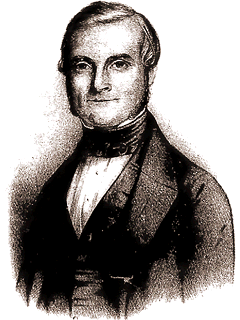
Return to top of the page
Return to: Oliver Cowdery's Bookshelf | Oliver Cowdery Home Page
last revised Mar. 10, 2008